

 We respect your privacy. Your information is safe.
The registration funnel is technically accessible. The audit came back clean, or close enough. Screen readers can navigate the form. Color contrast ratios pass. And yet: mobile page speed is still sluggish, Core Web Vitals are still amber, and conversion rates have not moved. The team followed the checklist. The checklist did not follow the user.
This is the scene on most high-traffic platforms after an accessibility push. The conformance work happened. The business case did not materialize. Leadership looks at the investment, looks at the dashboards, and files accessibility under "cost of compliance." The next time budget comes up, accessibility loses.
The problem is not the accessibility work. The problem is when it happened, and what it was allowed to touch. If your accessibility remediation is not moving performance metrics, the issue is almost certainly sequence — not effort.
Why Post-Launch Accessibility Audits Never Pay for Themselves
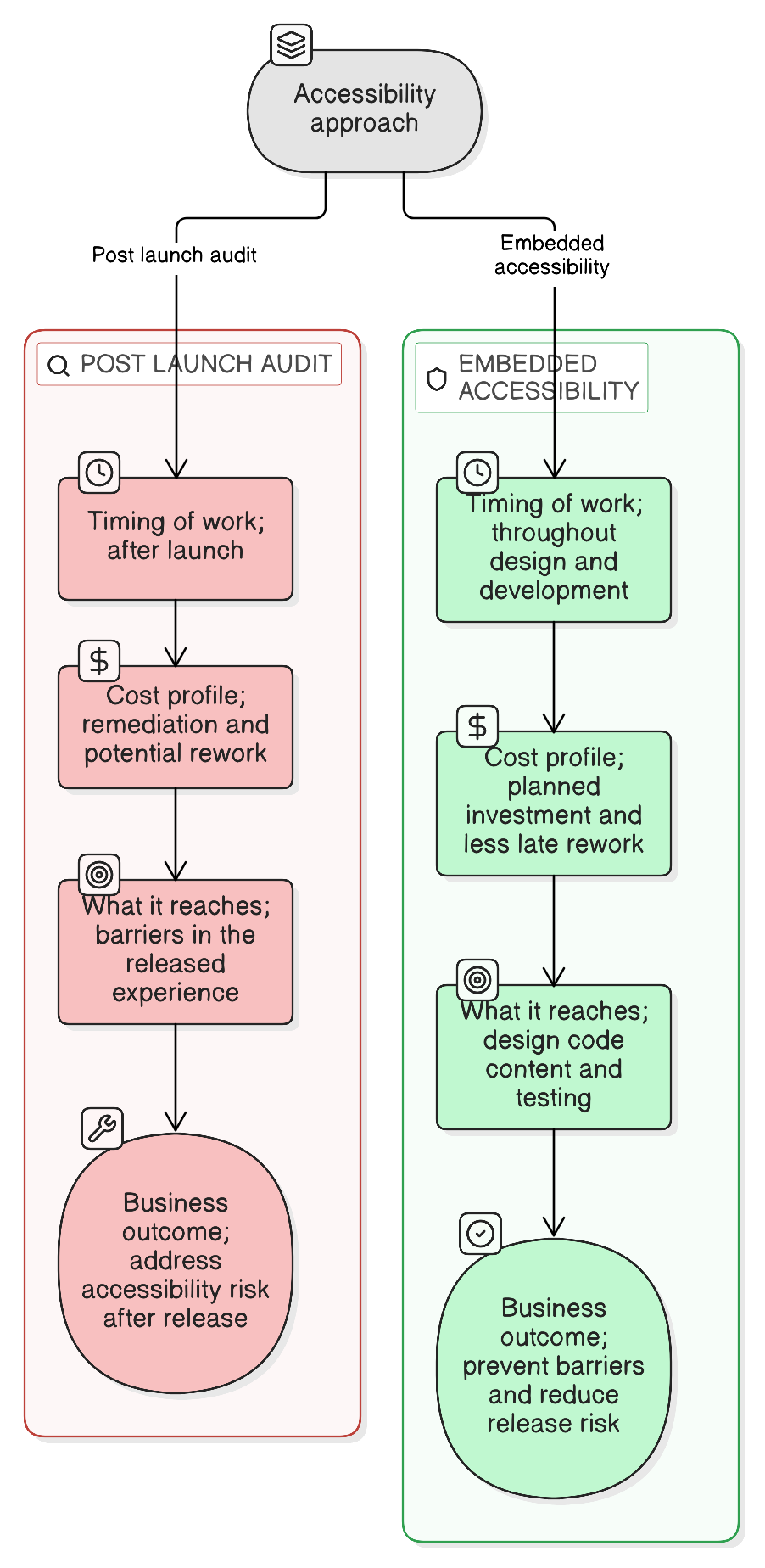
The standard approach treats accessibility as a QA gate. Build the platform, launch, then audit against WCAG criteria and remediate what fails. This is how most teams do it, and it is why most teams see accessibility as pure cost.
Here is why it disappoints mechanically. A post-launch audit finds issues that are baked into the architecture: DOM structures that bloat assistive-technology parsing, image delivery pipelines that serve heavy assets without responsive alternatives, JavaScript patterns that block interaction for keyboard and screen reader users while simultaneously degrading Core Web Vitals. Fixing those issues after launch means reworking what is already built, often under pressure, often incompletely.
The deeper failure is structural. When accessibility is scoped as a remediation pass, it never touches the decisions that actually determine both accessibility and performance: component architecture, image strategy, interaction patterns, content hierarchy. Those decisions were made weeks or months earlier, without accessibility at the table. The audit catches symptoms. It cannot reach causes.
The tool was never the problem. The sequence was.
This pattern plays out consistently across digital delivery — and it is not unique to accessibility. The same sequencing failure drives cost overruns in other disciplines, as explored in why most digital delivery fails before a single line of code is written.
How Embedding Accessibility as a Build Constraint Changes the Economics

Start with the experience architecture, not the conformance checklist. Accessibility requirements shape component design, content hierarchy, and interaction patterns before a line of front-end code is written. This is where the leverage lives. A component designed for semantic clarity from the start is lighter, faster, and more parseable by both assistive technologies and search engines. Retrofitting semantic structure into a component designed without it is consistently more expensive and rarely achieves the same performance profile, because the original architecture was never designed to support it.
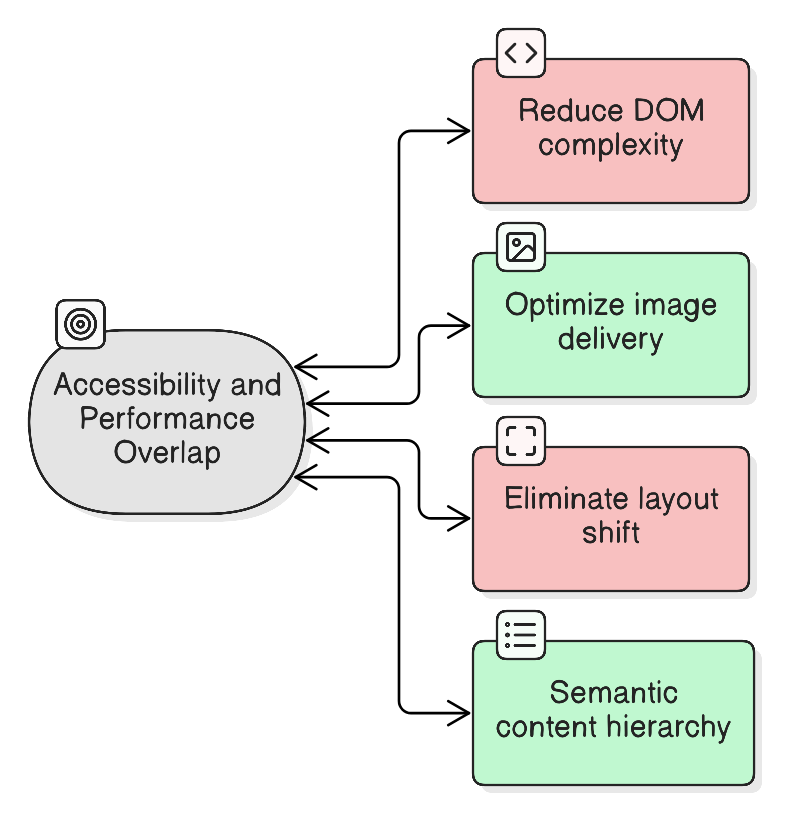
Treat performance and accessibility as a single constraint, not competing priorities. The interventions overlap more than most teams realize. Reducing DOM complexity improves both screen reader performance and rendering speed. Optimizing image delivery for responsive contexts serves both low-vision zoom users and mobile performance. Eliminating layout shift fixes both a WCAG 2.2 success criterion and a Core Web Vital. When these are separate workstreams with separate backlogs, the team solves the same structural problem twice, badly, on different timelines.
Embed conformance into the sprint, not after it. Accessibility acceptance criteria belong on every story that touches the front end, evaluated in the same review cycle as functional requirements. This is not additional overhead: it replaces the remediation cycle that would otherwise follow. The cost moves earlier in the timeline, where it is smaller, and disappears from the end, where it is largest.
Prioritize by user journey, not by WCAG success criterion. WCAG organizes requirements by technical category (perceivable, operable, understandable, robust). Users do not experience a platform by category. They experience it by journey: find an event, register, check results, track progress. Prioritizing conformance along the journeys that carry revenue — starting with registration and conversion paths — means the accessibility work that matters most to the business ships first. The conformance score follows the journey map, not the other way around.
This sequencing logic is the difference between accessibility as a cost center and accessibility as a performance intervention. The assessment determines the architecture; the architecture determines the platform. Reversing that order is how teams end up with clean audits and stagnant dashboards.
For a deeper look at why keeping accessibility in its own silo produces exactly this outcome, see why accessibility keeps costing more when compliance lives in its own silo.
What Changes When Accessibility Shapes Component Architecture
When accessibility requirements inform component design from the start, three things shift simultaneously. First, semantic HTML replaces div-heavy structures, reducing DOM node count and improving both screen reader traversal and browser rendering speed. Second, image delivery decisions — responsive sizing, lazy loading, format selection — are made once for all users rather than twice for separate workstreams. Third, interaction patterns that work for keyboard and assistive-technology users tend to reduce JavaScript complexity, which directly improves Time to Interactive scores.
These are not separate wins. They are the same architectural decision, made once, delivering compound returns across accessibility conformance, Core Web Vitals, and mobile performance simultaneously.
What This Looks Like on a Platform That Cannot Slip Its Deadlines
On a global endurance sports platform serving over two million monthly users, accessibility conformance was embedded as a first-order delivery constraint rather than a post-launch remediation workstream. The platform's reality made any other approach unworkable: 72% of traffic was mobile, content was event-driven with immovable race-day deadlines, and registration funnels were time-sensitive. There was no window for a remediation pass after launch. If accessibility was not in the sprint, it was not happening.
The team's accessibility practitioners worked cross-functionally with engineers rather than operating as a separate audit function. Conformance requirements shaped component decisions during build, not after. The practical effect was that the same architectural choices that improved assistive-technology support — reducing DOM complexity, optimizing content hierarchy, streamlining interaction patterns — also improved Core Web Vitals and mobile rendering performance.
The platform's metrics showed strong concurrent movement across the same period: users up 8%, sessions up 14%, search visibility improved 22% in average position, and 9.5 million conversion events recorded in a single month. Those are platform-level numbers influenced by multiple factors, including seasonality and parallel SEO work. Isolating the specific contribution of accessibility work to any single metric is not something the data cleanly supports, and claiming otherwise would be dishonest. What the engagement does demonstrate is that accessibility conformance, when sequenced as a build constraint rather than a remediation pass, did not compete with performance and growth objectives. It ran alongside them, shaped by the same architectural decisions, delivered in the same sprints.
That concurrent gain is the real finding. Not that accessibility "caused" revenue growth, but that the common industry framing — accessibility as a cost that competes with performance — is an artifact of the wrong delivery sequence.
What the Accessibility Business Case Actually Requires to Hold Up
Embedding accessibility as a delivery constraint is harder than running a remediation pass. It requires practitioners who understand both conformance requirements and component architecture, not just auditors who can flag failures. It means every front-end story takes longer to define, because acceptance criteria carry accessibility requirements alongside functional ones. Sprint velocity looks lower in the early weeks before the team internalizes the patterns.
It also does not eliminate the need for auditing. Automated tools still run. Manual testing with assistive technologies still happens. The difference is that those checks find edge cases rather than structural failures, which means remediation is measured in hours rather than sprints.
And the business case remains genuinely hard to prove in isolation. Accessibility improvements, performance improvements, and SEO improvements share so many root causes — cleaner DOM, better content hierarchy, faster rendering, more semantic markup — that attributing a conversion lift to any single discipline requires controlled testing that most teams do not run rigorously enough. We are building toward better attribution practices on this. We are not there yet.
What we can say plainly: on every engagement where we have embedded accessibility as a build constraint rather than a post-launch audit, the remediation cost at launch has been near zero, the performance work has moved faster, and the accessibility conformance has been more durable across release cycles. The compound return is in the delivery economics, not in a single dashboard metric.
If your platform serves a large, mobile-heavy audience and your accessibility work is not showing up in your performance metrics, the problem is probably not the accessibility work. It is probably the sequence. This is a pattern we explore further in why accessibility at the end of a build never works as well as you think.
Understanding the delivery sequence also matters in adjacent decisions. Teams building on Drupal, for example, face similar questions about when architectural constraints get locked in — explored in why your Drupal 7 migration keeps surfacing architecture questions you did not plan for.
Frequently Asked Questions
Why does accessibility remediation often fail to improve performance metrics?
Post-launch accessibility remediation addresses symptoms rather than causes. The architectural decisions that determine both accessibility and performance — component structure, DOM complexity, image delivery, interaction patterns — are locked in before the audit runs. Fixing those issues after launch means reworking existing architecture under delivery pressure, which rarely achieves the performance gains that designing for accessibility from the start would have produced.
What is the difference between accessibility remediation and embedding accessibility as a build constraint?
Accessibility remediation is a QA pass that happens after a platform is built, finding and fixing WCAG failures against a completed codebase. Embedding accessibility as a build constraint means conformance requirements shape component design, content hierarchy, and interaction patterns before front-end development begins. The build-constraint approach costs less overall because it eliminates the remediation cycle rather than appending to it.
How do accessibility improvements affect Core Web Vitals?
Accessibility and Core Web Vitals share architectural root causes. Reducing DOM complexity improves both assistive-technology parsing and browser rendering speed. Eliminating layout shift satisfies both WCAG 2.2 success criteria and the Cumulative Layout Shift Core Web Vital. Optimizing image delivery for responsive contexts serves low-vision zoom users and mobile Largest Contentful Paint simultaneously. When accessibility is treated as a build constraint, these improvements happen once rather than as separate workstreams.
How should teams prioritize accessibility work to maximize business impact?
Prioritize accessibility conformance by user journey rather than by WCAG success criterion category. Start with the journeys that carry the most revenue — typically registration, checkout, and conversion funnels — and ensure those paths are fully conformant before moving to secondary journeys. This approach means the accessibility work with the highest business impact ships first, rather than conformance work being distributed evenly across lower-priority platform areas.
Why is the accessibility business case so difficult to prove with data?
Accessibility improvements, performance improvements, and SEO improvements share the same root causes — semantic markup, DOM cleanliness, content hierarchy, rendering efficiency — which makes isolating the contribution of any single discipline to conversion or revenue growth extremely difficult without controlled testing. Most teams, including experienced digital delivery organizations, do not run that level of attribution rigor. The more defensible business case for embedding accessibility early is in delivery economics: remediation cost near zero at launch, faster performance work, and more durable conformance across release cycles.

Axelerant Editorial Team
The Axelerant Editorial Team collaborates to uncover valuable insights from within (and outside) the organization and bring them to our readers.

Leave us a comment