

 We respect your privacy. Your information is safe.
Here is something most teams building AI video capabilities will not say out loud: the tools are not the hard part anymore.
Runway, Pika, Sora, Kling, and a growing list of alternatives can all generate video from text prompts. The underlying models improve every few months. Access is cheap and getting cheaper. Any team with a credit card and an afternoon can produce AI-generated video.
And almost all of it looks like AI-generated video.
Not because the tools failed. Because nobody directed them.
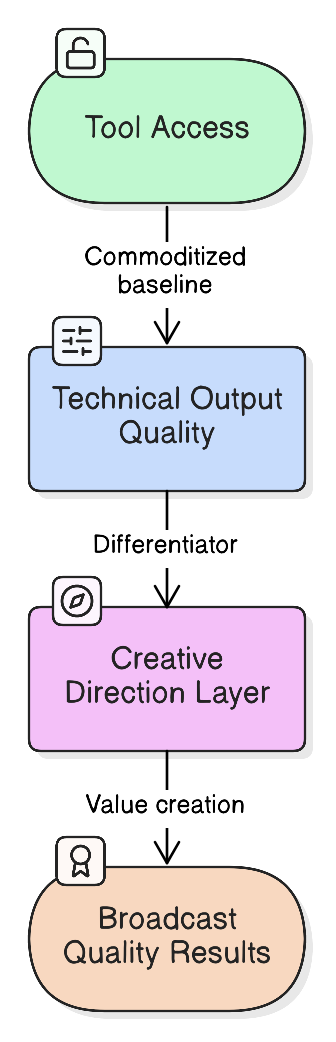
This is the core tension in AI video production right now. The technology layer has commoditized faster than anyone expected, but the creative direction layer has not scaled at all. The result is a market flooded with technically possible but creatively mediocre output, and a widening gap between teams that can make AI video look intentional and teams that cannot.
A recent webinar from Nextage, an AI video production company led by principals with 27+ years of art direction experience and backgrounds at major advertising holding networks, made this argument explicitly. Their thesis: creative direction, not tool access, is the moat. Their claimed results: 55% reduction in brief-to-delivery time and 80% reduction in cost per campaign compared to traditional production.
Those numbers deserve scrutiny (more on that below). But the underlying framework deserves more attention than the specific metrics, because it maps to a pattern that repeats across every technology commoditization cycle.
The Commoditization Curve Has A Predictable Shape
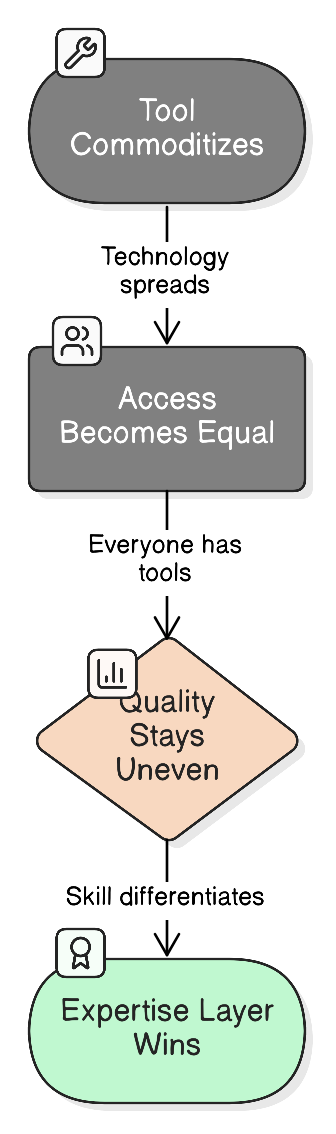
This is not the first time a production technology became universally accessible while quality remained unevenly distributed. It has happened before, and the pattern is consistent.
| Technology Wave | Tool That Commoditized | Layer That Became The Differentiator |
|---|---|---|
| Desktop publishing | PageMaker, QuarkXPress | Graphic design craft and typography expertise |
| Digital photography | DSLR cameras, Photoshop | Lighting, composition, post-production direction |
| Web development | WordPress, Squarespace | UX design, information architecture, content strategy |
| Social video | iPhone cameras, iMovie, Premiere | Storytelling, editing rhythm, platform-native formats |
| AI video (current wave) | Runway, Pika, Sora, Kling | Creative direction, prompt craft, art direction at the frame level |
The pattern is the same every time. When the technology layer becomes "good enough" and universally accessible, competition shifts to the adjacent expertise layer. Clayton Christensen described this as the law of conservation of attractive profits: when one layer of a value chain commoditizes, the profit opportunity migrates to an adjacent layer that has not yet commoditized.
In AI video, that adjacent layer is creative direction.
What "Creative Direction" Actually Means In AI Video
"Creative direction" risks becoming as vague as "strategy" if left undefined. In AI video production, it means something specific and measurable.
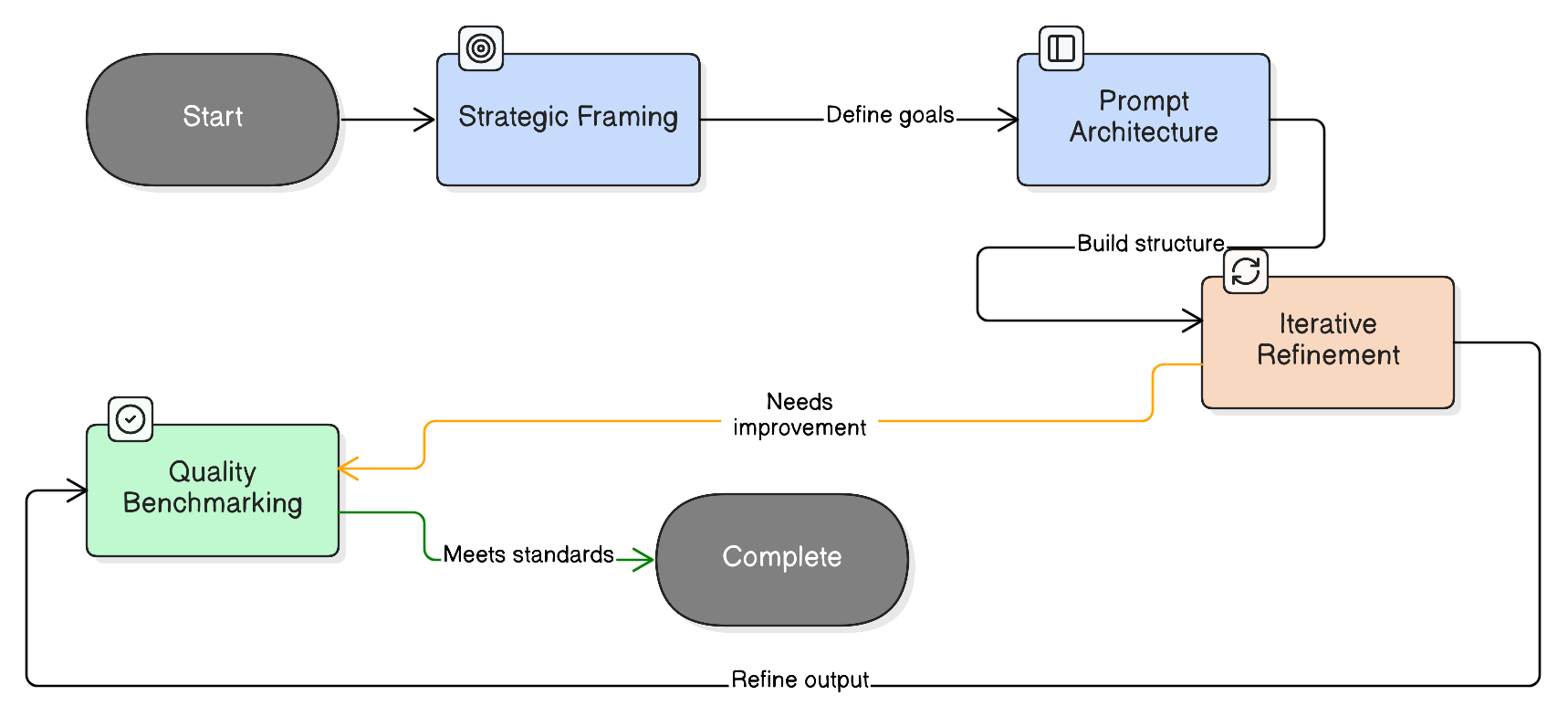
Creative direction in AI video production is the discipline of translating a brand's strategic intent into a sequence of constrained, iterative instructions that guide AI tools toward output indistinguishable from intentionally produced content.
That definition has four operative components.
Strategic Framing
Knowing what the video needs to accomplish before touching any tool. This is the same skill that makes a good traditional creative director valuable: the ability to bridge business objectives and visual storytelling. AI tools do not solve for intent. They solve for the literal content of a prompt. Without strategic framing, you get video that matches the words you typed but misses the point entirely.
Prompt Architecture
This is the AI-native skill layer. It is not "prompt engineering" in the generic sense. It is the ability to decompose a creative vision into a sequence of prompts that account for each tool's specific strengths, limitations, and failure modes. A director with decades of art direction experience understands composition, pacing, color theory, and visual hierarchy at a level that translates into dramatically different prompts than someone without that training. The same scene description, structured by someone who understands the rule of thirds and color temperature, produces fundamentally different output.
Iterative Refinement
AI video tools rarely produce final output on the first generation. The craft is in the iteration loop: knowing which outputs to keep, which to regenerate, which to composite, and when to switch tools entirely. This is judgment work, not technical work. It requires the same editorial eye that a film editor or post-production supervisor brings, recalibrated for AI-specific artifacts and failure modes. A skilled director might generate 40+ variations of a single scene and know within seconds which three are worth refining.
Quality Benchmarking
The most critical and least discussed component. What does "good enough" mean? For social media filler, the bar is low. For broadcast or near-broadcast work, the bar is specific: frame consistency, motion coherence, lighting continuity, brand-accurate color reproduction. A creative director with traditional production experience carries those benchmarks implicitly. Someone without that background often does not know what to look for, which means they approve output that a trained eye would flag as substandard.
The Four-Option Landscape For Teams Investing In AI Video
Most organizations evaluating AI video capabilities face four options. Each involves a different bet on where value accrues.
| Approach | Cost Profile | Quality Ceiling | Speed | Core Risk |
|---|---|---|---|---|
| In-house teams using AI tools directly | Low tool cost, high learning curve cost | Varies wildly by team's creative baseline | Fast after ramp-up | Output looks generically AI-generated without experienced direction |
| Traditional production agencies | $50K, $500K+ per campaign | High (proven craft) | 8, 12 weeks typical | Budget and timeline pressure makes this unsustainable at volume |
| AI-native studios (tool-led) | Low to moderate | Medium, inconsistent across projects | Fast | Technology pitch masks creative direction gap |
| AI-native studios (direction-led) | Moderate | High, if direction layer is genuinely strong | Fast (claimed 55% faster than traditional) | Must continuously prove direction layer justifies cost above DIY |
The Nextage positioning sits squarely in the fourth row. Their argument: you are not paying for access to AI tools (you already have that), you are paying for decades of art direction applied to those tools.
This is a compelling frame. It is also one that requires continuous proof, because the moment a client believes their in-house team can direct AI tools adequately, the value proposition collapses.
Examining The Claimed Metrics
Nextage claims a 55% reduction in brief-to-delivery time and an 80% reduction in cost per campaign. These numbers warrant careful evaluation.
| Metric | Claimed | What We Do Not Know | Evidence Strength |
|---|---|---|---|
| Brief-to-delivery time reduction | 55% | Baseline comparison (55% faster than what? ). Industry standard is 8, 12 weeks for a full campaign. Is this measured against that range? | Low to moderate. Self-reported in a marketing context with no third-party validation visible. |
| Cost per campaign reduction | 80% | Baseline comparison (80% less than what? ). A mid-tier campaign ranges from $50K to $500K+. Sample size is unknown. | Low to moderate. Same self-reporting caveat. |
These metrics are plausible directionally. AI-assisted production should be significantly faster and cheaper than traditional production by eliminating physical shoots, reducing crew sizes, and compressing post-production timelines. Whether the specific numbers hold across multiple campaigns at consistent quality levels is unverifiable from publicly available information.
The honest assessment: treat these as indicative of the magnitude of change AI-assisted production can deliver, not as benchmarked guarantees. Any team making purchase decisions should ask for project-specific case studies with named baselines and comparable scope.
The Framework: Where To Invest When The Tools Are Commoditized
For teams navigating this shift, the investment decision comes down to a two-axis framework evaluating how much you invest in tool capabilities versus how much you invest in creative direction capabilities. The four resulting positions determine your output quality ceiling and your competitive differentiation.
| Low Direction Investment | High Direction Investment | |
|---|---|---|
| High Tool Investment | "Demo reel" quality. Technically impressive, creatively generic. Useful for internal prototyping. Not brand-safe at scale. | Maximum output quality. This is where broadcast-adjacent AI video lives. Requires either deep in-house creative talent retrained for AI, or a direction-led production partner. |
| Low Tool Investment | Baseline experimentation. Fine for learning, not for production. Most teams start here. | Wasted potential. Strong creative vision with inadequate tool fluency. Outputs under-deliver on the director's intent. |
The strategic insight: most organizations over-invest in the tool axis, licenses, training on specific platforms, chasing each new model release, and under-invest in the direction axis: hiring experienced directors, building creative review processes calibrated for AI output, developing quality benchmarks.
This is the equivalent of buying a professional camera and expecting the equipment to produce professional photographs. The camera is necessary. It is not sufficient.
Three Practical Steps For Teams Making This Transition
First, audit your existing creative direction capacity. Do you have people on staff who can articulate visual quality standards at the frame level? Who understand composition, pacing, and brand-consistent visual language? If yes, retrain them on AI tool capabilities and limitations. If no, this is your gap, and no amount of tool investment will close it.
Second, separate tool evaluation from direction evaluation. When reviewing AI video output, ask two distinct questions: "Did the tool perform adequately? " and "Was the direction good enough? " These are different failure modes with different solutions. Conflating them leads to switching tools when you should be improving direction, or vice versa.
Third, establish quality benchmarks before production begins. Define what "broadcast quality" or "brand safe" or "good enough for social" means in specific, visual terms. Reference frames. Approved color palettes. Motion coherence standards. Without these, creative review becomes subjective and inconsistent, and AI video output drifts toward the generic middle.
What This Means Beyond Video
The "creative direction is the moat" argument extends well beyond video production. The same dynamic is playing out across every domain where generative AI has made the production step dramatically easier. And the implications are concrete for how organizations structure teams, evaluate vendors, and allocate budgets.
Hiring changes. The most valuable AI-assisted creative hire is not someone who knows the tools best. It is someone who has the deepest craft expertise in the output domain and can learn the tools. An art director with 15 years of experience who learns Runway in a month will outperform a prompt engineer with no visual training every time. This inverts the instinct most hiring managers follow, which is to hire for AI fluency first and domain expertise second.
Team structure changes. The traditional production model separates creative direction from execution. In AI-assisted production, the director and the operator can be the same person, because the execution barrier has dropped so dramatically. This compresses the team from a creative director plus a producer plus a crew of 12 into a creative director with AI tool fluency and perhaps one technical compositor. The ratio of directors to operators should flip. Instead of one director overseeing many producers, you want many directors each operating their own tools.
Vendor evaluation changes. When evaluating any AI-assisted creative partner, the question should not be "what tools do you use? ", they all use the same ones. The question should be "show me your creative direction process. " What does their brief intake look like? How do they define quality benchmarks? What does their iteration workflow look like? How many rounds of refinement does a typical project go through? A partner that leads with tool names is telling you they have not figured out what actually matters yet.
Budget allocation changes. This framework suggests that a significant portion of what organizations currently spend on AI tool licenses and platform training should be redirected toward creative upskilling and direction infrastructure. A $50, 000 investment in retraining three experienced art directors on AI video tools will produce better output than a $50, 000 investment in enterprise licenses for the latest generation model. The tools will change in six months. The direction skills compound permanently.
This pattern, the technology commoditizes and the judgment layer above it becomes the differentiator, is not a temporary market quirk. It is the structural logic of every creative technology wave, and it has held for over three decades. Organizations that internalize this now will build durable creative capabilities. Organizations that chase tool advantages will find themselves re-investing every cycle with nothing compounding underneath.
Frequently Asked Questions
Why Does AI Video Still Look "AI-Generated" Even With Advanced Tools?
AI video tools optimize for prompt fidelity, not creative intent. Without experienced direction, output defaults to generic compositions, inconsistent lighting, and predictable motion patterns. The gap is a creative direction problem: someone who understands the rule of thirds, color temperature, and pacing will write fundamentally different prompts than someone without that training.
Can In-House Teams Develop AI Video Creative Direction Capabilities?
Yes, if they already have strong creative foundations in place. Teams with experienced art directors or cinematographers can retrain for AI tools within weeks. Teams without that baseline creative judgment need to hire for it first. Tool training alone will not bridge the gap, because the missing skill is visual quality judgment, not software proficiency.
How Should Organizations Evaluate AI Video Production Partners?
Ask to see the creative direction process, not the tool stack. Request frame-level quality comparisons against traditional production at comparable scope. Require named baselines for any claimed cost or time metrics. Any partner that leads with technology names rather than creative review workflows is signaling that direction is not their primary competency.
Is The 80% Cost Reduction In AI Video Production Realistic?
Directionally, yes, because AI production eliminates physical shoots, reduces crew sizes, and compresses post-production timelines. Specific savings depend on baseline comparison, campaign scope, and quality requirements. Self-reported vendor metrics should be validated against project-specific case studies. Ask for the baseline number the percentage is calculated from.
What Is The Most Common Mistake Teams Make When Adopting AI Video?
Over-investing in tools and under-investing in direction. Most teams buy licenses, train on platforms, and chase each new model release while neglecting to build the creative judgment layer that determines output quality. The result is technically competent video that looks generic. Redirecting even a portion of tool spend toward creative upskilling produces measurably better output.

Axelerant Editorial Team
The Axelerant Editorial Team collaborates to uncover valuable insights from within (and outside) the organization and bring them to our readers.

Leave us a comment