

 We respect your privacy. Your information is safe.
Every professional services firm sitting on delivery data hits the same wall the moment they build an internal AI tool: how much of your own operational truth do you expose to it?
Lock everything down and the AI has no context. A coaching tool that cannot see what someone actually worked on will produce the same generic advice as a static career portal. Open the full operational database and cost rates, utilization metrics, and client-identifying details are all in the context window, one unexpected model behavior away from surfacing in a career development conversation.
The architectural challenge is drawing the boundary between those two failure modes.
Why this matters now
Professional services firms are building AI tools on top of their own data faster than they are thinking about what that data contains. A coaching tool, a skills matcher, a project staffing recommender: each one needs grounding in real delivery evidence to be useful. Self-reported profiles are stale the week they are written. The system of record, where project history, certifications, and demonstrated skills actually live, is the only source that makes an AI tool worth talking to.
But that same system of record also holds cost rates, utilization metrics, margin data, and client-identifying details. Surfacing all of it to an AI coaching layer creates real exposure risk. The question is not whether to use delivery data. It is which categories of delivery data belong in a coaching conversation and which do not.
What Axelerant built, and the boundary it drew
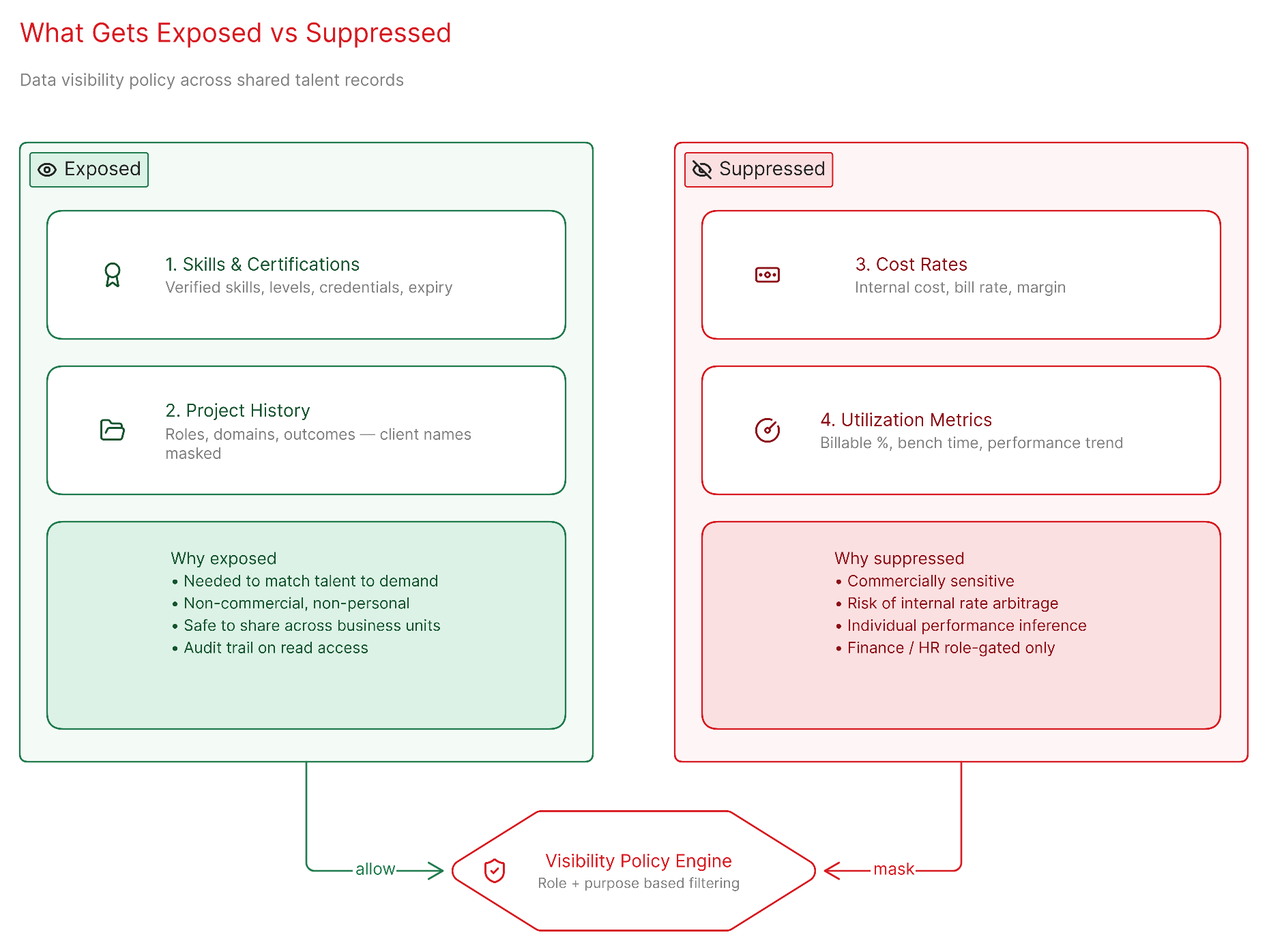
An engineering team at Axelerant recently built and shipped exactly this kind of boundary layer. The team created an MCP server that exposes a curated, redacted, versioned bundle of delivery data to an internal AI coaching and growth tool. The data it surfaces: skills, certifications, project history. The data it deliberately suppresses: cost metrics and utilization rates.
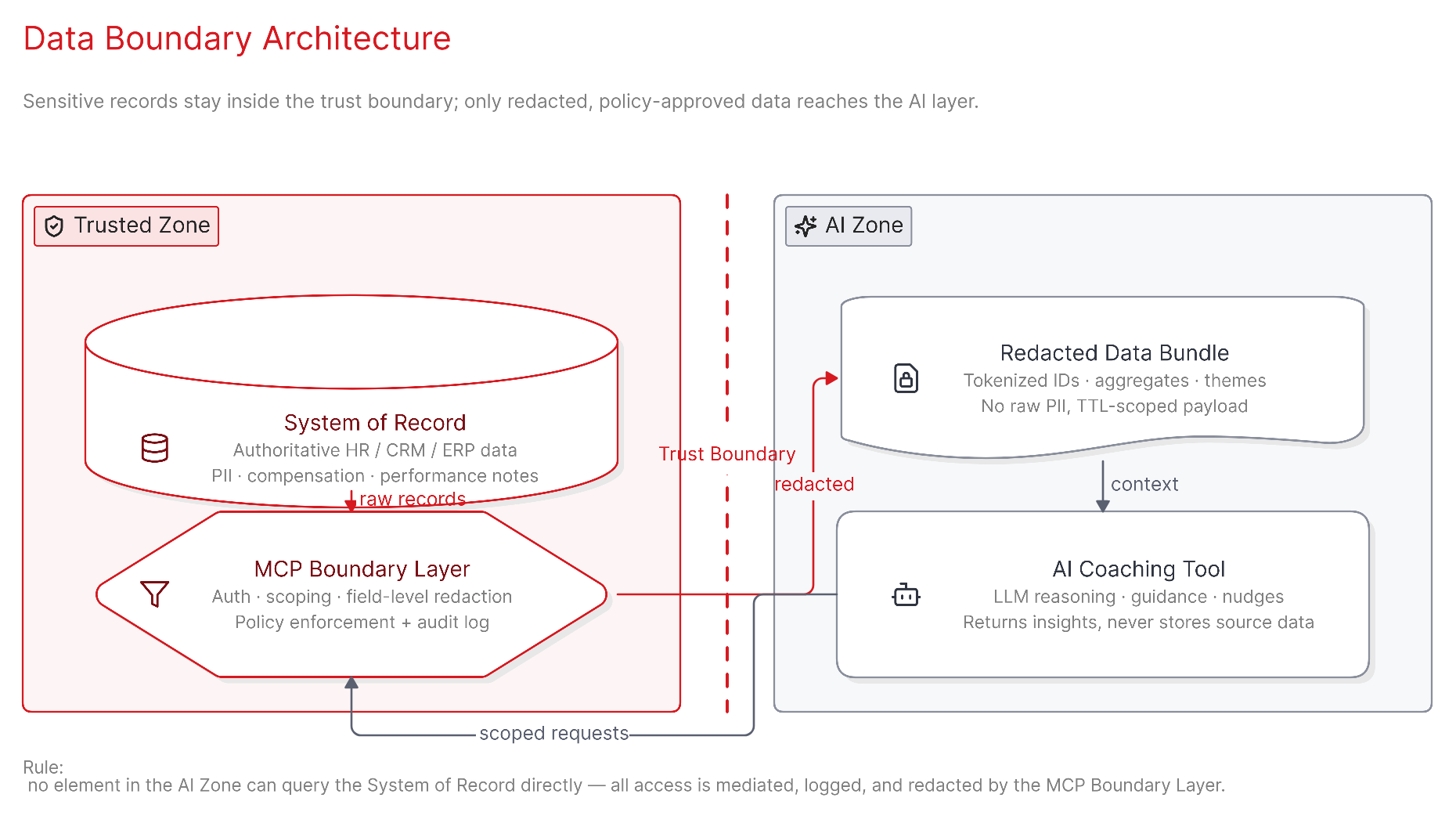
The decision worth examining is not the server itself. It is the category-level boundary. The team did not default to "expose everything" or "expose nothing. " They made a deliberate architectural choice: skills demonstrated on a project, yes. The margin on that project, no. Certifications earned, yes. The cost rate attached to the person who earned them, no.
The versioning matters too. A snapshot-based approach means the AI tool consumes a known, reproducible state of the data. If redaction logic needs updating, the previous version still exists and the team can audit exactly what the AI had access to at any point.
This build is still early. The coaching tool consuming this data layer has no adoption metrics yet, no before-and-after comparisons of coaching quality, and no evidence about whether delivery-grounded AI coaching actually changes how people develop. The engineering pattern is sound. Whether it produces the outcome it was designed for is an open question we will know more about as the integration matures.
Why direct access and self-reported profiles both fail
The two most obvious alternatives to a curated boundary layer each break for a specific, structural reason.
Direct database access gives the AI tool everything, including data it should never surface. Even if the model is instructed to ignore sensitive fields, the information is in the context window. The boundary has to exist in the data layer itself, not in the prompt. Instructional suppression is not architectural suppression, and the difference matters the first time the model reasons across fields you thought were hidden.
Self-reported profiles solve the sensitivity problem by avoiding real data entirely, which also avoids usefulness. The whole point of grounding the AI in delivery evidence is that the system of record knows what someone actually did, not what they remember to list on a profile page.
The sequence that makes the boundary hold
The use case has to come before the data model. Define what the AI tool actually needs to do its job: a coaching tool needs project history, demonstrated skills, and credentials. It does not need cost rates. The use case draws the boundary. The boundary determines the data engineering architecture, not the other way around.
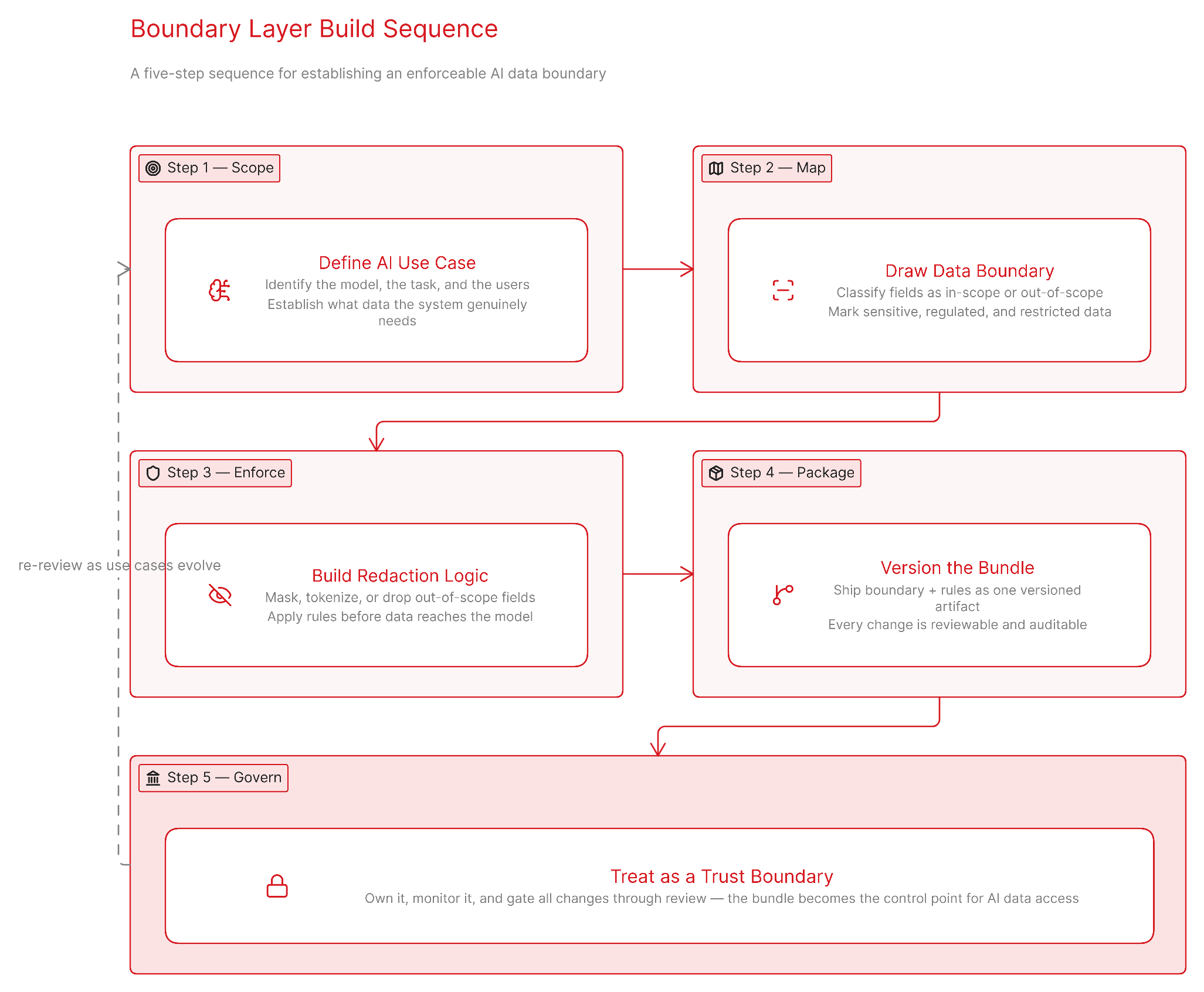
The redaction logic then has to be a first-class architectural decision, not a filter bolted on after the integration ships. Document which categories are exposed and which are suppressed, and document why. That documentation is the artifact that keeps the boundary from eroding the next time someone asks "can we just add one more field? "
Version the bundle. Treat the AI tool as an untrusted consumer, even when it is internal, even when your own team built it. The boundary between operational truth and AI-consumable context is a trust boundary. Design it like one.
What this does not solve
This pattern handles the supply side: what data the AI tool can see. It does not handle the demand side: what the AI tool does with it. A well-bounded data layer does not prevent the model from producing bad advice, does not guarantee that project history translates into meaningful skills inference, and does not answer the harder question of whether AI-assisted career development actually helps people grow.
The redaction boundary itself is a judgment call. Reasonable people will disagree about where to draw it. Some will argue that consultants should see their own utilization data and that suppressing it is paternalistic. Others will argue that even project history is too revealing when client confidentiality matters. The boundary is a starting position that needs revisiting as the tool matures and as the organization learns what exposure actually does to behavior.
Once the boundary exists and the redaction logic runs, subsequent internal AI integrations can inherit a governed data layer instead of re-solving the same exposure problem from scratch. Whether that compounds depends on whether the organization treats the first boundary as precedent or as a one-off. The pattern is reusable. The discipline to reuse it is organizational, not architectural.

Axelerant Editorial Team
The Axelerant Editorial Team collaborates to uncover valuable insights from within (and outside) the organization and bring them to our readers.

Leave us a comment