
 We respect your privacy. Your information is safe.
Pre-validated delta migration is a cloud migration pattern that prioritizes zero data loss over zero downtime — a critical distinction for platforms with encrypted per-customer data, inter-service authentication chains, and workflow pipelines where duplicate execution or dropped jobs are unacceptable.
Most cloud migration guidance optimizes for zero downtime. Run both environments. Shift traffic gradually. Roll back if something breaks. For stateless services behind a load balancer, this works.
It stops working the moment your platform includes encrypted per-customer data, inter-service authentication chains, and workflow pipelines where duplicate execution or dropped jobs are unacceptable. In those environments, running two clouds simultaneously does not reduce risk. It multiplies it. Every minute both environments accept writes is a minute you may need to reconcile divergent encrypted data across two different key stores.
Pre-validated delta migration is a cloud migration pattern that optimizes for a different constraint: zero data loss, provably. It accepts a bounded, planned outage in exchange for eliminating an entire class of data integrity risks.
This pattern was architected for a specific engagement: planning the migration of a production cybersecurity platform — five interconnected applications with encrypted per-customer vulnerability findings — from one major cloud provider to another. What follows is the methodology as designed, presented as a reusable pattern for teams facing similar constraints. For teams evaluating how delivery rigor reduces broader program risk, see how delivery teams reduce migration risk and build executive confidence.
Where The Standard Cloud Migration Playbook Breaks Down
Consider a platform with characteristics drawn from a real DAST (Dynamic Application Security Testing) system:
| Component | Role | Why Parallel Operation Is Dangerous |
|---|---|---|
| Configuration backend | Serves API data consumed by two downstream apps | Config drift between clouds means downstream apps behave differently depending on which source they hit |
| Customer-facing web application | Renders verification checklists from backend data | If the backend is split across clouds, customers see inconsistent data |
| Vulnerability triage system | Stores encrypted per-customer findings, orchestrates scans via workflow engine | Encrypted findings written under source cloud keys while the triage interface reads from target cloud keys creates a split-key problem |
| SSO authentication service | Issues access tokens trusted by the triage system | Token trust chain must resolve to exactly one environment |
| Public IP verification service | Consumed by external assessors outside the organization | External users need a single, stable address |
Five applications. Multiple databases. Encrypted per-customer data stores. A workflow pipeline. An SSO chain. External consumers with no visibility into the migration.
A parallel-run approach for this class of platform requires real-time cross-cloud data replication, a dual-key-store encryption strategy, cross-cloud authentication token validation, and duplicate scan pipeline execution prevention. Each of these is a substantial engineering effort. Together, they amount to building temporary infrastructure that exists only to avoid a planned maintenance window. For teams wrestling with similarly complex data structures, the validation gap between storage and screen describes related failure modes worth understanding before cutover.
The Pre-Validated Delta Migration Pattern: A 4-Phase Framework
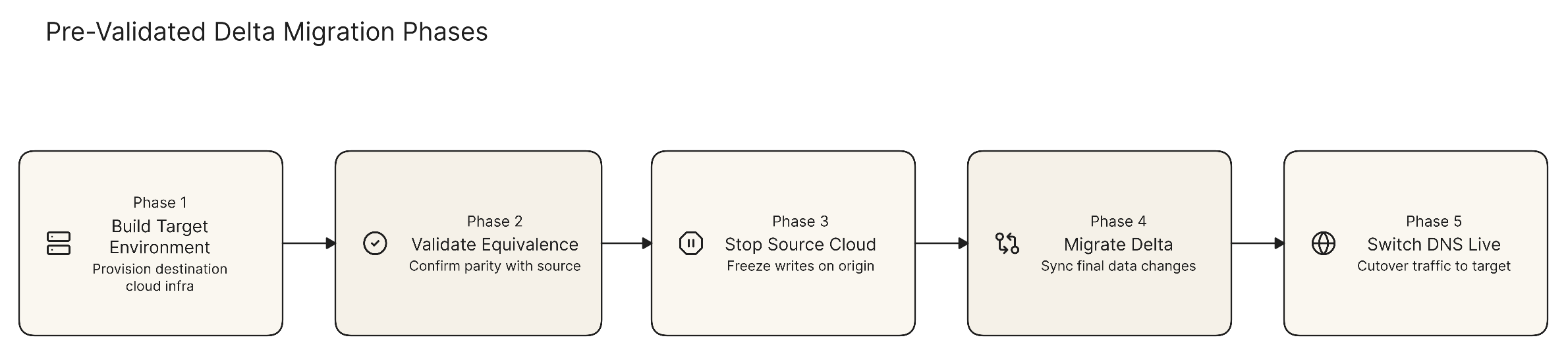
Pre-validated delta migration is a methodology that front-loads the vast majority of migration work into a low-pressure preparation phase, so the actual cutover window contains only the minimum necessary operations. The core principle: do the hard, slow work when no clock is ticking, so the time-pressured work is small and well-rehearsed.
Phase 1: Build And Load The Target Environment
Well before the planned cutover, the target cloud environment is fully provisioned. Every application is deployed from infrastructure-as-code. Every database receives a complete data load from the production source. Every secret — database credentials, encryption keys, SSO client secrets — is provisioned in the target's secrets management system.
This is not a staging environment. It is a production-grade replica. The only data missing is the delta: writes that occur between the full load and cutover day.
Phase 2: Validate Equivalence Before Committing To Cutover
With the target fully loaded, a validation pass compares the target's data and application behavior against the live source. This is where the "pre-validated" in pre-validated delta migration earns its name — validation happens before the cutover window opens, not during it.
| Validation Area | What Is Compared |
|---|---|
| Database integrity | Record counts, schema consistency, referential integrity |
| Encrypted data | Per-customer findings are accessible and correctly secured under target key store |
| Application behavior | API responses, UI rendering, configuration consistency |
| Authentication | SSO login flow completes; tokens are issued and validated correctly |
| Workflow pipeline | Pipeline configuration is present and correctly mapped to target infrastructure |
By the time cutover day arrives, the team already knows the target environment works. The remaining question is bounded: can the delta be migrated cleanly?
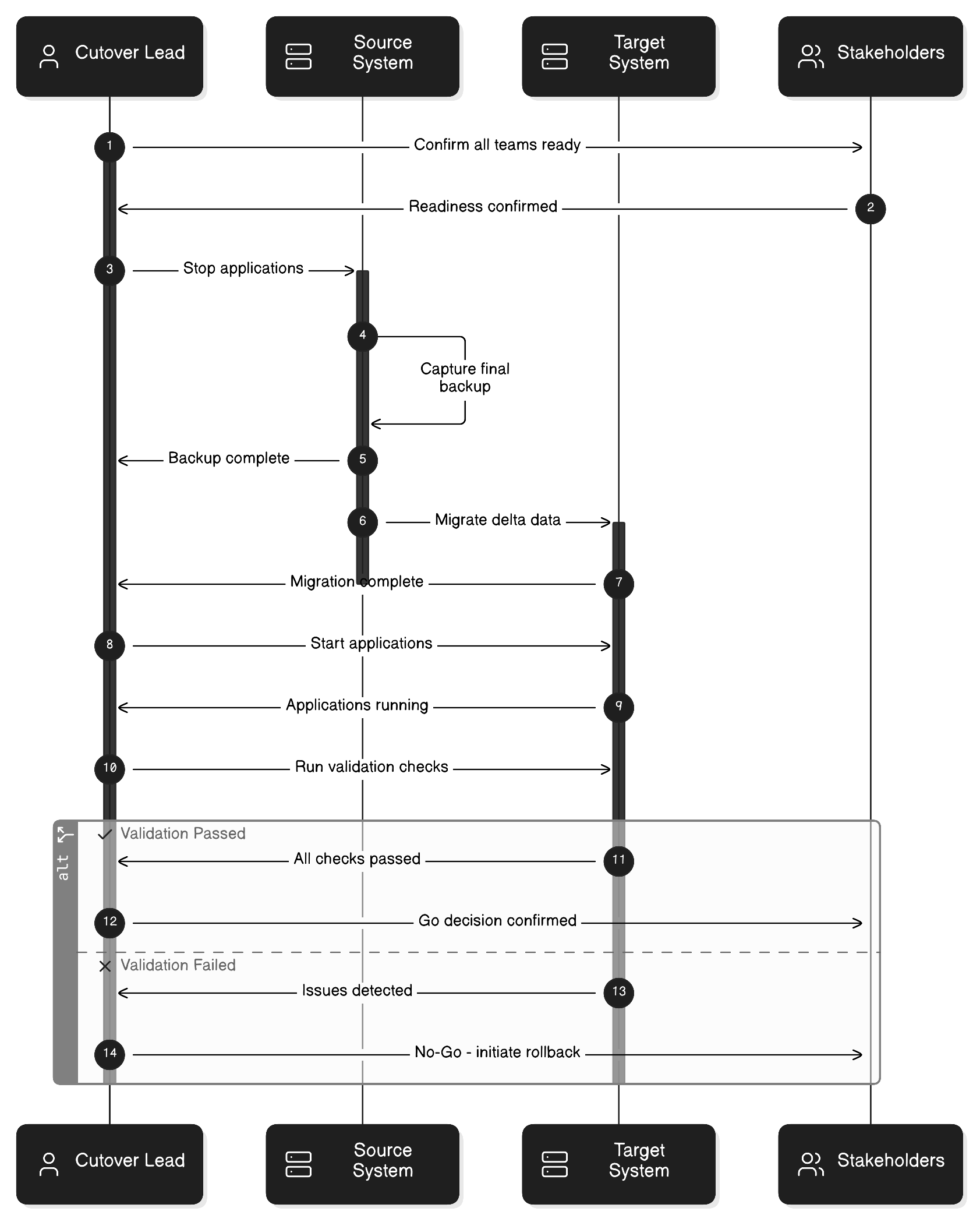
Phase 3: Stop Source, Migrate Delta, Switch — The Zero Data Loss Cutover
On cutover day, the execution is deliberately linear. No parallel writes. No split-brain risk. The two environments are never live at the same time — that constraint is the mechanism that makes data integrity provable.
| Step | Action | Purpose |
|---|---|---|
| 1 | Confirm readiness: all approvals merged, rollback snapshots taken | Ensure no blockers remain |
| 2 | Stop all source cloud applications | Guarantee no new writes occur |
| 3 | Back up source databases (final state capture) | Preserve rollback point |
| 4 | Compute data delta since last full load | Identify exactly what changed |
| 5 | Migrate delta to target databases and file storage | Bring target current |
| 6 | Re-secure encrypted data under target key store | Maintain encryption chain continuity |
| 7 | Start target applications with migrated data | Target becomes the live environment |
| 8 | Switch DNS to target addresses | Route traffic to target |
| 9 | Validate end-to-end: data, auth, pipeline, customer-facing behavior | Confirm everything works |
| 10 | Go/no-go decision | Single authority decides whether to proceed or roll back |
In the engagement where this pattern was designed, the planned estimate for Phase 3 was 3 to 4 hours. Actual cutover duration for any given cloud-to-cloud migration will depend on delta size, number of encrypted tenants requiring re-securing, and validation depth. Teams migrating from Drupal 7 to modern platforms face an analogous scoping challenge described in why platform migration is never just a migration.
Phase 4: Preserve Rollback Until Stability Is Confirmed
The source environment is stopped, not deleted. Pre-cutover snapshots are taken before any data modification. If the go/no-go check fails, the source can be restarted from its frozen state. No data reconciliation is needed because the source never accepted writes after it was stopped.
The source is retired only after the target has been confirmed stable over a defined observation period.
Why Stop-Source-First Beats Parallel-Run For Encrypted, Stateful Workloads
The instinct to run parallel environments comes from a reasonable desire to preserve a fallback. For stateful applications with encrypted per-customer data, however, the parallel approach creates problems that are harder to solve than a planned outage is to schedule.
| Concern | Parallel-Run Approach | Stop-Source-First Approach |
|---|---|---|
| Data consistency | Requires real-time replication or reconciliation logic between clouds | Guaranteed: only one environment accepts writes at any point |
| Encrypted data integrity | Findings may be encrypted under source keys in one environment and target keys in another | All findings re-secured under target key store in a single controlled pass |
| Workflow pipeline state | Risk of duplicate execution or orphaned jobs | Pipeline migrated as a unit; no partial state |
| Rollback complexity | Both environments have diverged data; rollback requires reverse-reconciliation | Source state is frozen at a known point; rollback is a restart, not a merge |
| Outage duration | Potentially zero, but with unbounded reconciliation risk if something goes wrong | Bounded and planned |
For platforms where encrypted data integrity is a compliance or contractual requirement, accepting a bounded planned outage removes more risk than it introduces. You eliminate data reconciliation, split-key encryption, and duplicate pipeline execution as failure modes — in exchange for a maintenance window your team controls. This same risk calculus applies to infrastructure-as-code migrations, as explored in this infrastructure-as-code case study.
The Encryption Key Continuity Problem In Cloud-To-Cloud Migration
The most technically demanding element of pre-validated delta migration is re-securing encrypted data under the target cloud's key management system.
When a platform stores findings encrypted on a per-customer basis, each customer's data is isolated and encrypted with keys managed through the platform's secrets infrastructure. Moving to a different cloud provider means those findings must be decrypted from the source key store and re-encrypted under the target key store. This must happen with full per-customer isolation maintained, zero data written to intermediate unencrypted storage, and auditability of every record touched during the re-securing pass.
This is the operation that makes a parallel-run approach genuinely untenable for this class of workload. You cannot maintain two simultaneously valid encryption states across two cloud key stores without building a key synchronization layer that itself becomes a new attack surface and a new reconciliation problem. The stop-source-first approach eliminates this entirely: re-encryption happens once, in a single controlled pass, against a known-complete dataset.
For teams building security-critical platforms where data handling practices intersect with compliance requirements, secure coding best practices covers the foundational principles that inform decisions like this one.
When To Use Pre-Validated Delta Migration
This pattern is not the right choice for every cloud migration. It is the right choice when one or more of the following conditions apply:
- Per-customer encrypted data stores — where parallel key management creates irreconcilable state
- Authentication chains with a single trust root — where token validity cannot span two environments simultaneously
- Workflow pipelines with exactly-once execution requirements — where duplicate job execution has real-world consequences
- External consumers with no migration visibility — where a stable, single endpoint is contractually or operationally required
- Compliance environments — where data residency, encryption chain continuity, or audit trails are regulated
For stateless services behind load balancers, blue-green or canary deployments remain the better choice. The mistake is applying those patterns to stateful, encrypted workloads because they are familiar — not because they fit. Teams evaluating which migration approach fits their specific platform architecture can explore cloud migration and adoption work in financial services for a comparable constraint environment.
Frequently Asked Questions
What is pre-validated delta migration?
Pre-validated delta migration is a cloud migration pattern that front-loads environment build, data load, and validation work into a preparation phase before the cutover window opens. On cutover day, the source environment is stopped to guarantee no new writes, the data delta since the last full load is migrated to the target, and DNS is switched. The two environments are never live simultaneously, which makes data integrity provable rather than probabilistic.
Why is zero downtime migration dangerous for encrypted, stateful applications?
Parallel-run zero-downtime migration requires both environments to accept writes simultaneously, which creates divergent data states across two cloud key stores. For platforms with per-customer encrypted data, this produces a split-key problem: findings written under source cloud keys cannot be read by the target cloud's key management system without a synchronization layer that introduces new security and reconciliation risks. A planned, bounded outage eliminates this class of failure entirely.
What is the delta in pre-validated delta migration?
The delta is the set of writes that occur between the initial full data load to the target environment and the moment the source is stopped on cutover day. Because the source is stopped before the delta migration begins, the delta is finite and computable. Migrating a bounded, known dataset is fundamentally safer than attempting live replication between two active environments.
How long does the cutover window take with this pattern?
The cutover window duration depends on three variables: the size of the data delta since the last full load, the number of encrypted tenants requiring re-securing under the target key store, and the depth of end-to-end validation performed after the switch. In the cybersecurity platform engagement where this pattern was designed, the planned estimate for the cutover phase was 3 to 4 hours.
What does rollback look like if the cutover fails?
Rollback in the pre-validated delta migration pattern is a restart, not a merge. Because the source environment is stopped rather than deleted, and pre-cutover snapshots are taken before any data modification, the source can be restarted from its frozen state if the go/no-go check fails. No data reconciliation is required because the source never accepted writes after it was stopped — its state at rollback is identical to its state at the moment of shutdown.

Axelerant Editorial Team
The Axelerant Editorial Team collaborates to uncover valuable insights from within (and outside) the organization and bring them to our readers.

Leave us a comment