

 We respect your privacy. Your information is safe.
Most AI-powered internal tools fail for a boring reason. They don't know anything real about the people they're supposed to help.
An AI coaching system that can't see what a practitioner has actually delivered, which projects they've worked on, what skills they've demonstrated, what certifications they hold, defaults to generic advice. Generic advice gets ignored. Ignored tools get cut. The investment evaporates. The interesting engineering problem is not "how do we give the AI access to real data. " It's "how do we give it access to real data without exposing bill rates, utilization numbers, client-identifying details, or margin data to an interface that practitioners interact with directly. "
That's the problem one of our engineering teams just solved. And the architectural decision at the center of it is more transferable than the tool itself.
The cost of keeping AI tools generic
Organizations building AI tooling on top of their own operational data are hitting a governance wall, whether they realize it or not. The wall has two sides.
On one side: an AI system grounded in generic prompts produces output that feels like it was written by someone who has never met you. In a coaching context, that means recommendations disconnected from what a person has actually done. Practitioners sense the gap immediately. Adoption craters.
On the other side: opening a direct connection between an AI consumer and a production database is a fast way to surface data that was never meant for that audience. Cost data. Bench time. Client contract terms. Margin figures. In a professional services environment, that information is commercially sensitive. Exposing it through a conversational AI interface, even accidentally, is not a hypothetical risk. Language models can surface data they were instructed to suppress. Prompt-level redaction is not a governance mechanism. It's a suggestion.
Most teams building internal AI integrations frame this as a retrieval problem: "how do we get the right context into the prompt? " The retrieval framing skips the governance question entirely, and the governance question is the one that determines whether the tool ships safely or ships with a latent leak.
What we actually built
Our engineering team built and shipped a dedicated server, part of a Model Context Protocol (MCP) architecture, that bundles practitioner delivery evidence into a redacted, versioned format consumable by an internal AI-powered coaching and growth system. The server sits between the organization's delivery data and the AI consumer. Three design choices carry the argument for why this pattern works.
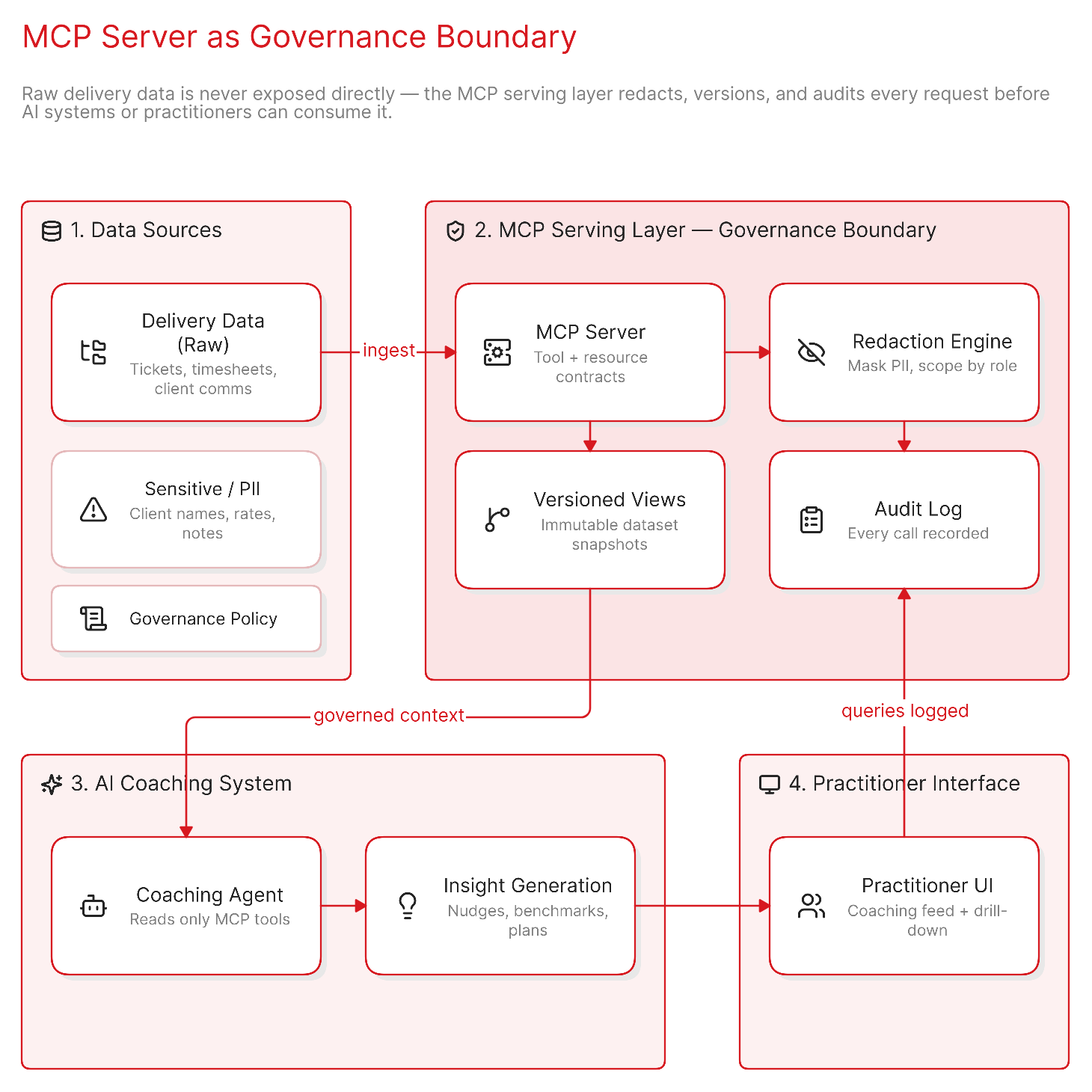
Redaction lives in the serving layer, not the AI layer. The bundle strips cost data, utilization figures, and client-identifying information before anything reaches the AI system. Redaction is not a filter applied at query time or an instruction embedded in a system prompt. It is a transformation built into the server itself. The AI system never receives the sensitive fields, which means it cannot surface them, regardless of how the prompt is constructed or how the model behaves. The engineering team's observation during the build was direct: once you accept that prompt-level data suppression is unreliable, the entire architecture follows. You stop asking "how do we tell the model to ignore this? " and start asking "how do we never send it in the first place? "
The bundle is versioned. Changes to a practitioner's record produce a new version rather than overwriting the previous one. Any coaching output the AI generates can be traced back to the specific evidence snapshot it was grounded in. When someone asks "why did the system recommend this? ", the answer is auditable. That traceability is the foundation for trust in the system's outputs.
The governance boundary is an engineering constraint, not a policy request. This is the decision that matters most. The instinct is to handle data governance inside the AI layer: filter results after retrieval, instruct the model to ignore certain fields, build guardrails around the output. Every one of those approaches puts the boundary in a place the AI system can override. A governed serving layer means the AI consumer operates within boundaries it cannot cross, not because it was told to, but because the sensitive data never enters its context.
Why the simpler approaches fail
Direct database access would have coupled the AI system to the data schema and exposed every field, including the ones that should never reach a practitioner-facing interface. Every schema change becomes an exposure risk.
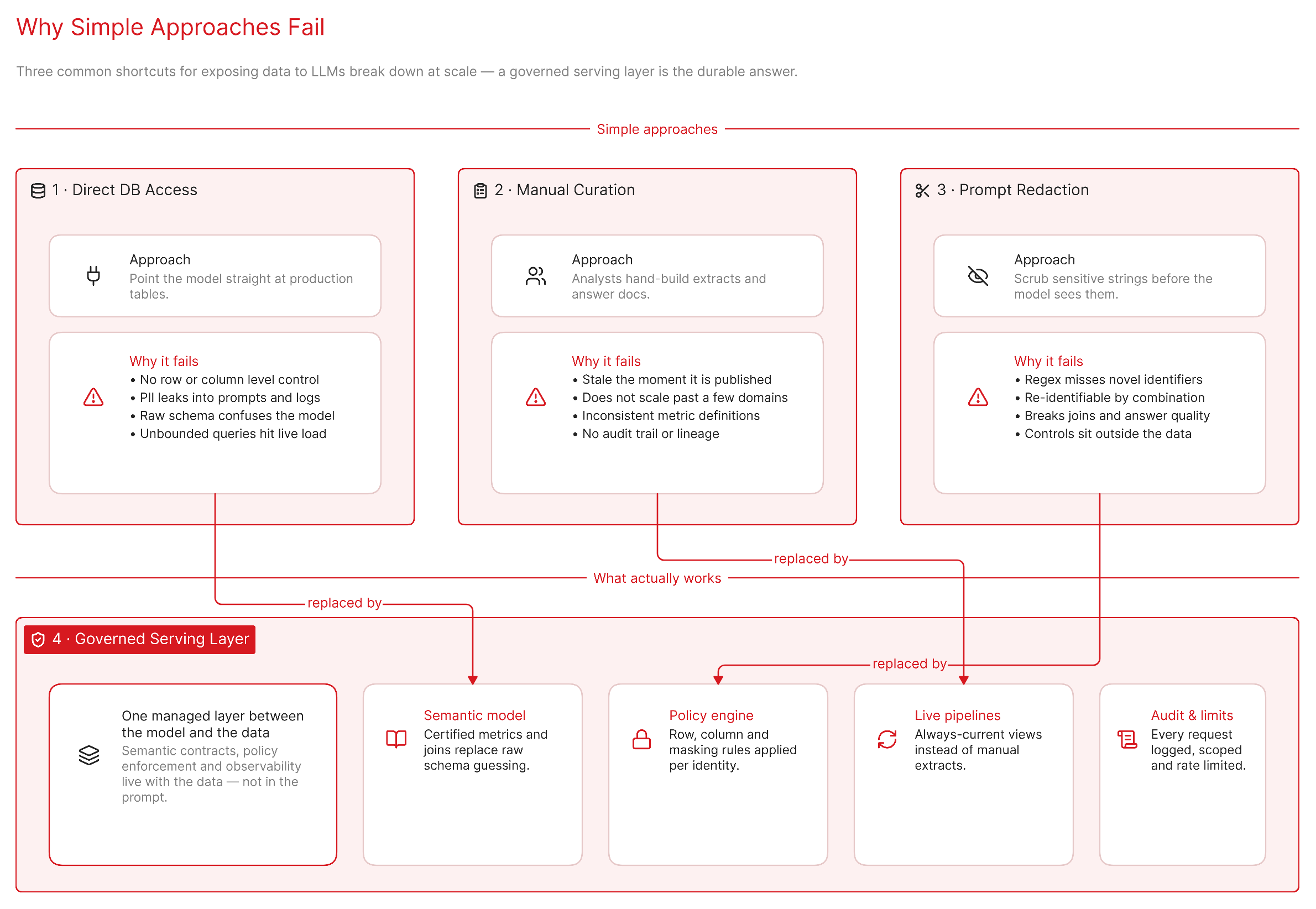
Manual curation of practitioner profiles goes stale the day it's published. In a consultancy, delivery history changes weekly. A manually maintained evidence base is a snapshot of the past wearing a current-date label.
Prompt-level redaction ("ignore cost fields, do not mention client names") is the most common approach and the least reliable. Models do not reliably suppress information present in their context window. If the data is in the context, it can appear in the output. The only reliable redaction is the kind where the data never enters the context at all.
The transferable principle
The principle underneath this build is simple enough to be framework-agnostic: put your data governance boundary in the serving layer, not in the AI layer.
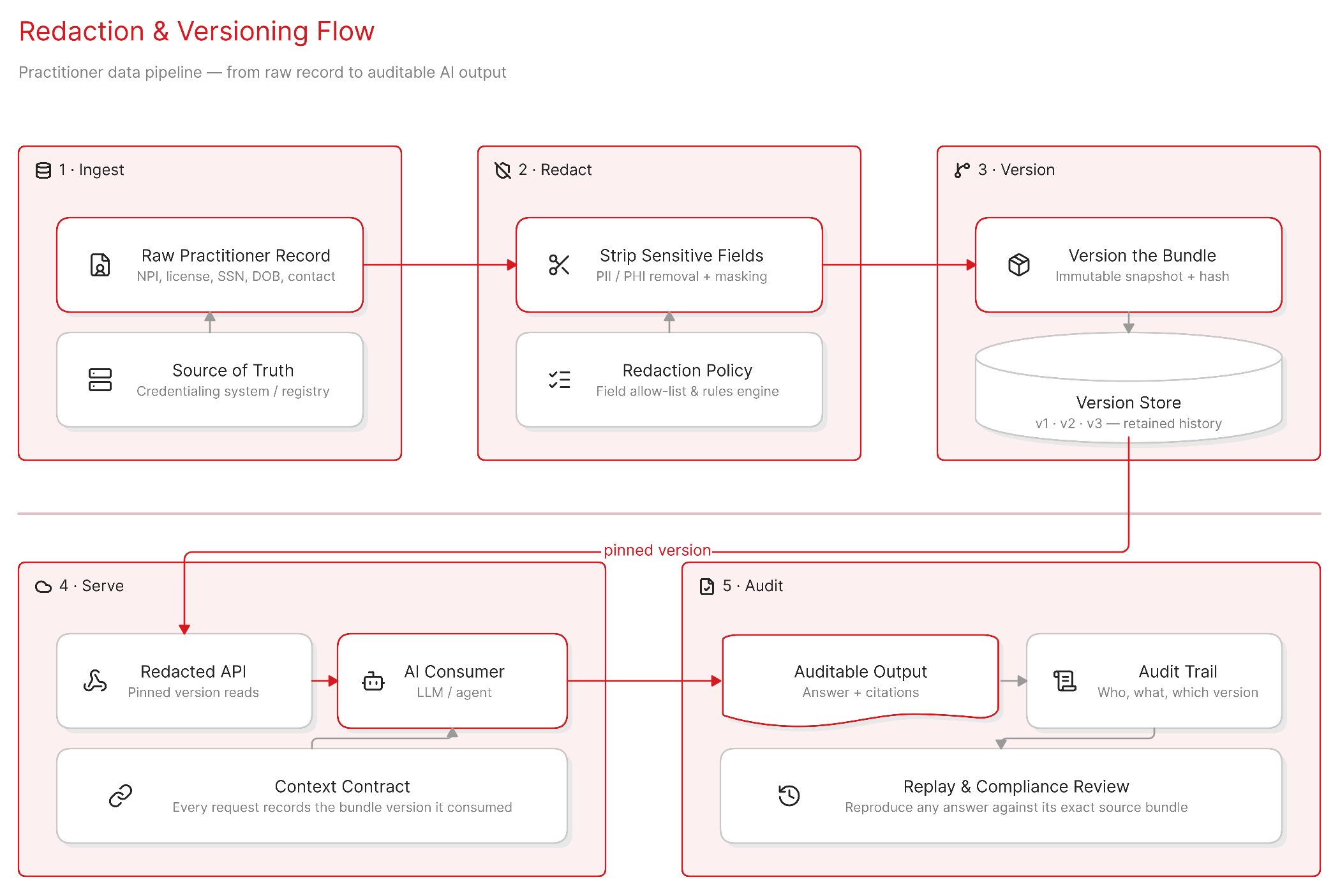
When the governance boundary lives in the AI consumer, every model update, every prompt change, every new feature is a potential exposure event. When it lives in the serving layer, the AI consumer operates in a governed sandbox by default. New features, new prompts, new models: none of them can access what the server never served.
This applies beyond coaching tools. It applies to any internal AI system that needs access to HR data, project records, financial history, customer information, or operational metrics where some fields are appropriate for AI consumption and others are not. The MCP architecture provides one implementation path, but the architecture decision is what matters: does the AI system receive everything and promise to ignore some of it, or does it receive only what it should see? One of those is an engineering boundary. The other is a hope.
What this does not solve
This is a "we shipped it" story, not a "here's what happened" story. The server is merged and the integration path exists, but we do not yet have usage data, adoption metrics, or before-and-after quality comparisons for the coaching system's outputs. We plan to measure those and will share what we find. Claiming outcomes before measuring them is exactly the kind of AI storytelling we're trying to avoid.
The redaction logic itself is an ongoing design commitment. Every time the underlying data model changes, someone has to decide what the new fields mean for the governance boundary. Automation can flag the question. A human has to answer it. The serving layer enforces the boundary; it does not define it.
And there is a harder question we have not solved: what happens when the AI system needs to reason across data that includes the redacted fields to produce a useful output? There are coaching scenarios where cost context or utilization patterns would make the recommendation meaningfully better. The current answer is that the system produces less complete recommendations in exchange for a governance boundary it cannot violate. Whether that tradeoff holds long-term is an open question we are watching closely.
If your organization is working through how AI tooling should interact with operational data, talk to our team. We are building these patterns in production, not in theory.

Axelerant Editorial Team
The Axelerant Editorial Team collaborates to uncover valuable insights from within (and outside) the organization and bring them to our readers.

Leave us a comment