

 We respect your privacy. Your information is safe.
Agent-based APM tools like New Relic fire alerts based on data reported by an agent running inside the application. That design means something specific for headless commerce stacks: if the agent itself cannot report, because the application is down, because a CDN layer is blocking requests, because the problem sits upstream of instrumented code, no alert fires. The monitoring system designed to catch outages has a structural blind spot for an entire category of outages.
This is not a misconfiguration. It is how agent-based monitoring works. The gap between "the application reports healthy" and "a customer can actually reach the storefront" exists in every architecture, but headless commerce makes it wider and harder to detect.
Composable stacks multiply the failure surfaces APM cannot see
A monolithic commerce platform concentrates risk. The frontend, the catalog, the checkout, the content all live in one deployable unit. One health check covers most of the customer experience.
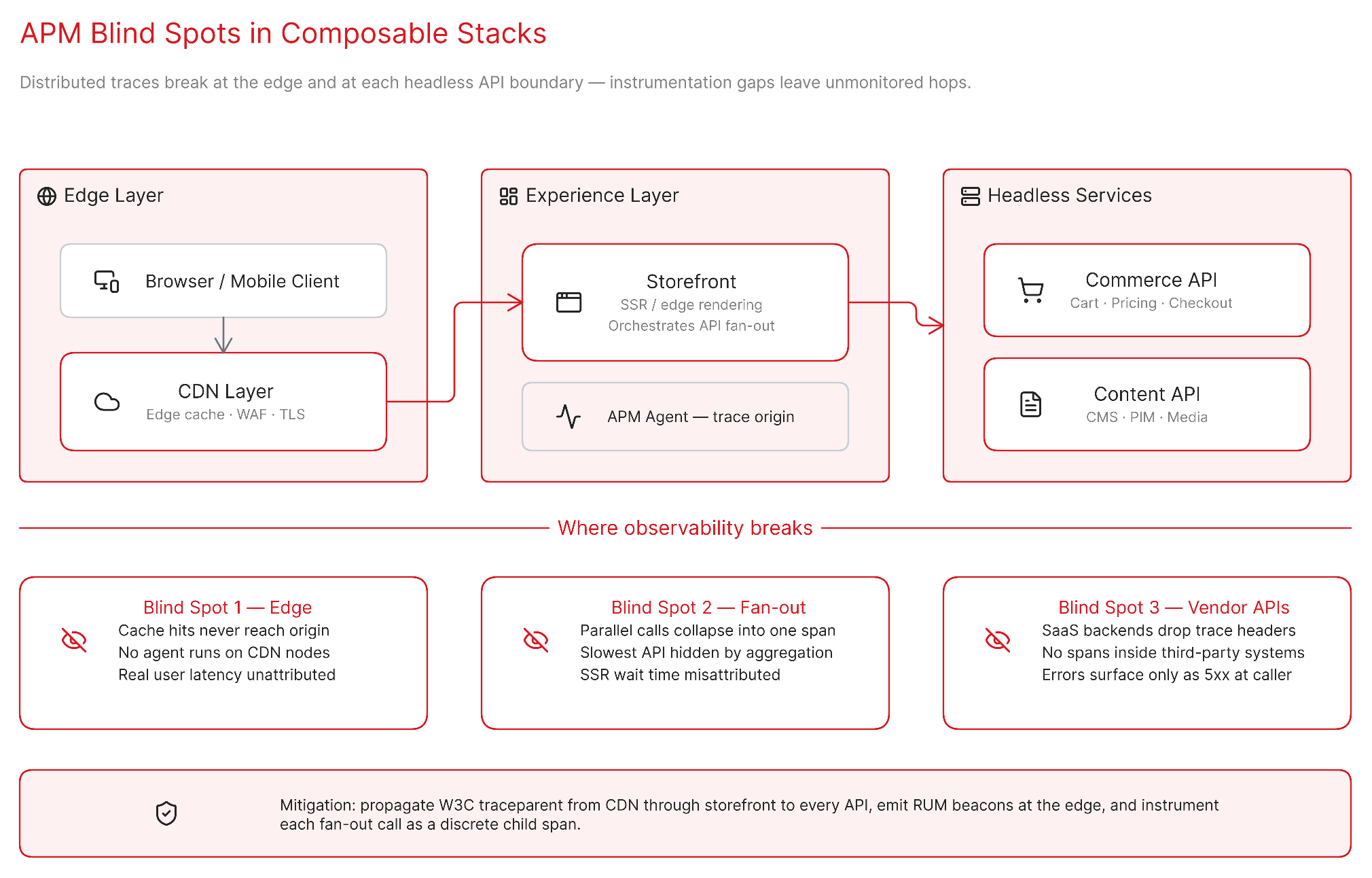
A composable commerce stack distributes that risk across independent services. A production architecture running a decoupled storefront that consumes a Magento GraphQL API for commerce data and a Strapi GraphQL API for content has three independent endpoints. Each has its own infrastructure, its own deployment pipeline, and its own failure modes. The storefront can return a 200 while the content API is down, producing a page that loads but shows empty sections where product descriptions or editorial content should appear. The commerce API can time out while the storefront serves cached pages that look fine until a customer tries to add something to a cart.
These partial failures are the operational signature of composable architectures. They are also the failure mode that agent-based APM handles worst. The agent on the storefront has no opinion about whether the Strapi API is reachable from outside the network. The agent on the commerce backend has no visibility into the CDN layer sitting between the user and the storefront. Each agent watches its own service from inside. Nobody is watching from outside, where the customer is.
Two questions, two monitoring layers
The distinction is simple enough to state in a sentence, and consequential enough to build infrastructure around.
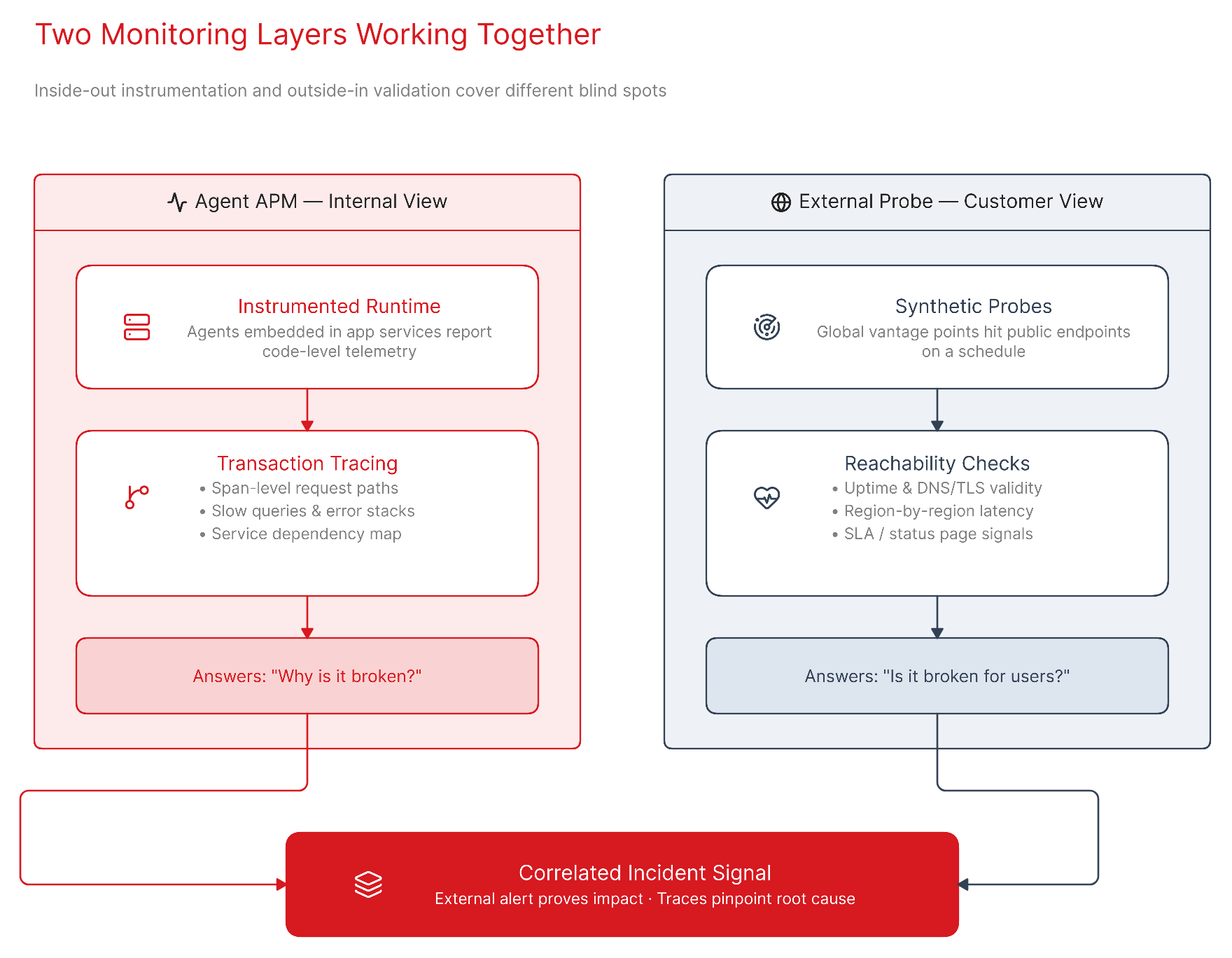
Agent-based APM answers: "Is this application performing as expected, from the application's own perspective? " External uptime monitoring answers: "Can a real user, from a real network, actually reach this endpoint right now? "
These questions diverge in three scenarios that are routine, not exotic, in composable commerce:
- Total application failure. The agent cannot report because nothing is running to host it. Depending on alert configuration, the APM dashboard shows an absence of data rather than an alarm. Silence looks different from an outage only if someone is watching the dashboard at the right moment.
- Upstream infrastructure failure. A DNS resolution failure, a CDN misconfiguration, a certificate expiry, a network-level block. The application is healthy. The application is also unreachable. The agent, sitting inside the application boundary, sees nothing wrong.
- Failure in an uninstrumented service. Deep APM coverage on the commerce backend does not help when the CMS API, which may have lighter or no instrumentation, stops responding. The storefront degrades. The APM dashboard for the commerce service stays green.
The common thread: every scenario involves a failure that is visible to the customer but invisible to the agent. That is the blind spot, and it is architectural, not accidental.
Closing the gap without replacing what works
The fix is additive. External synthetic monitoring layers alongside the existing APM stack. Agent-based telemetry continues doing what it does well: transaction tracing, error classification, performance profiling, deep application diagnostics. External probes add what it structurally cannot provide: the view from outside.
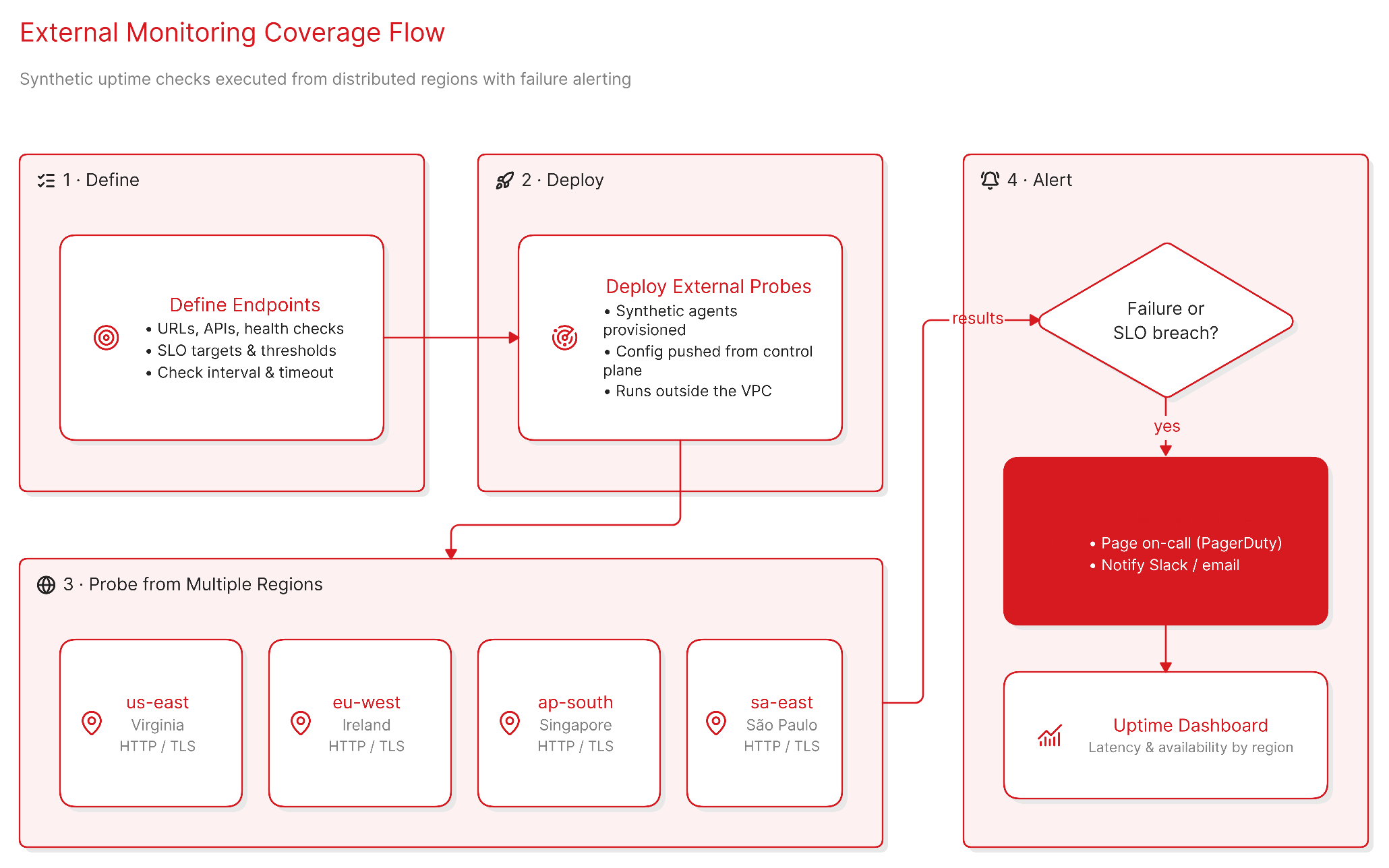
For a headless commerce stack, this means identifying every production endpoint a customer depends on and configuring an external monitor for each one independently. In the Magento-plus-Strapi pattern, that is three monitors at minimum: the storefront, the Magento GraphQL API, and the Strapi GraphQL API. Tools like Site24x7, Pingdom, or Datadog Synthetics send requests from multiple geographic regions on a regular interval, answering the reachability question from the user's perspective. The specific tool matters less than the architectural decision to have an external vantage point at all.
The configuration details that make external monitoring operationally useful, rather than just technically present, depend on context. Check frequency, geographic distribution of probes, alert thresholds tuned to your caching and fallback behavior, escalation policies, integration with the same incident management channel your APM alerts use: these decisions vary by architecture and team maturity. A storefront 503 and a content API 500 have different customer impact depending on your edge caching. The monitoring configuration should reflect what each failure actually means for the buying experience, not just whether an HTTP request returned a success code.
What this does not make easy
External uptime monitoring closes the reachability gap. Stating clearly what it does not close matters more than overselling what it does.
It will not catch performance degradation that falls short of an outage. A storefront that loads in twelve seconds instead of two is reachable. It is also unusable. Performance monitoring remains the domain of APM and real-user measurement.
It will not catch data correctness failures. Stale prices, out-of-sync inventory, broken content references: these require synthetic transactions or end-to-end test suites that validate business logic, not just availability. A monitor that confirms the Magento GraphQL endpoint returns a 200 tells you nothing about whether the data in that response is right.
And the harder truth: the monitoring layer is the easier half of the problem. The difficult work is the on-call culture and incident response discipline that can act on what the monitors surface. Alert fatigue from poorly-tuned thresholds, unclear escalation paths when a partial failure does not map cleanly to one team's ownership, missing runbooks for the specific failure modes composable architectures produce: these are the problems that persist after the observability gap is closed. The tooling is a prerequisite. The operational maturity to use it well is a longer build.
Teams running headless commerce architectures are making a deliberate trade: composability and flexibility in exchange for a larger, more complex operational surface. That trade is worth making. The monitoring posture has to keep pace with the architectural ambition, and the external observability layer is one of the first places where the gap between the two becomes visible.
The question that reveals the gap
Ask your engineering team: "If our storefront went completely unreachable right now, which system would tell us, and how fast? " If every answer routes through your APM tool, the blind spot described here applies. The pattern for closing it is well-established and the tooling is commodity. The decision that matters is the architectural one: ensuring an external perspective exists, independent of whether the application's own instrumentation is functional.
If your composable commerce architecture has outgrown your observability coverage, Axelerant's Platform Engineering team can help you map the gaps and close them.

Axelerant Editorial Team
The Axelerant Editorial Team collaborates to uncover valuable insights from within (and outside) the organization and bring them to our readers.

Leave us a comment