
 We respect your privacy. Your information is safe.
The martech landscape hit 15, 505 tools in 2026. If you have been waiting for consolidation to simplify your decisions, that wait is the problem. The market is not consolidating. It is stratifying: winners are emerging within categories, a long tail persists, and a new layer of AI agents is forming on top of everything you already run. The mental model most organizations use to make stack decisions is outdated, and it is costing them in paralysis, misplaced bets, or both.
Why this matters now
Most marketing and technology leaders are operating with one of three assumptions, and all three are wrong.
The first: consolidation is coming, so wait it out. This leads to decision paralysis. Teams defer platform investments, tolerate duct-taped integrations, and lose ground to competitors who moved. The second: AI will replace the stack, so rip and replace. This leads to expensive experiments built on tools that cannot function without the deterministic infrastructure underneath them. The third: it is too early to act, so watch from the sidelines. This one is quieter but just as costly. Agent-optimized customer journeys are not a speculative forecast. They are arriving now, and organizations without a plan for them are already falling behind.
The State of Martech 2026 research from Scott Brinker and Frans Riemersma provides the empirical frame that dissolves all three assumptions. The landscape is not shrinking. Specific categories like CMS, iPaaS, eCommerce, and workflow tools are growing. Eight categories are in quiet decline. The story is not "fewer tools. " It is "different tools winning in different layers, for different reasons. " That distinction changes how you audit, how you buy, and how you staff.
The two-layer model that reframes your architecture conversations
The most useful framing from the research is architectural. Your stack is not one thing. It is two layers doing fundamentally different work.
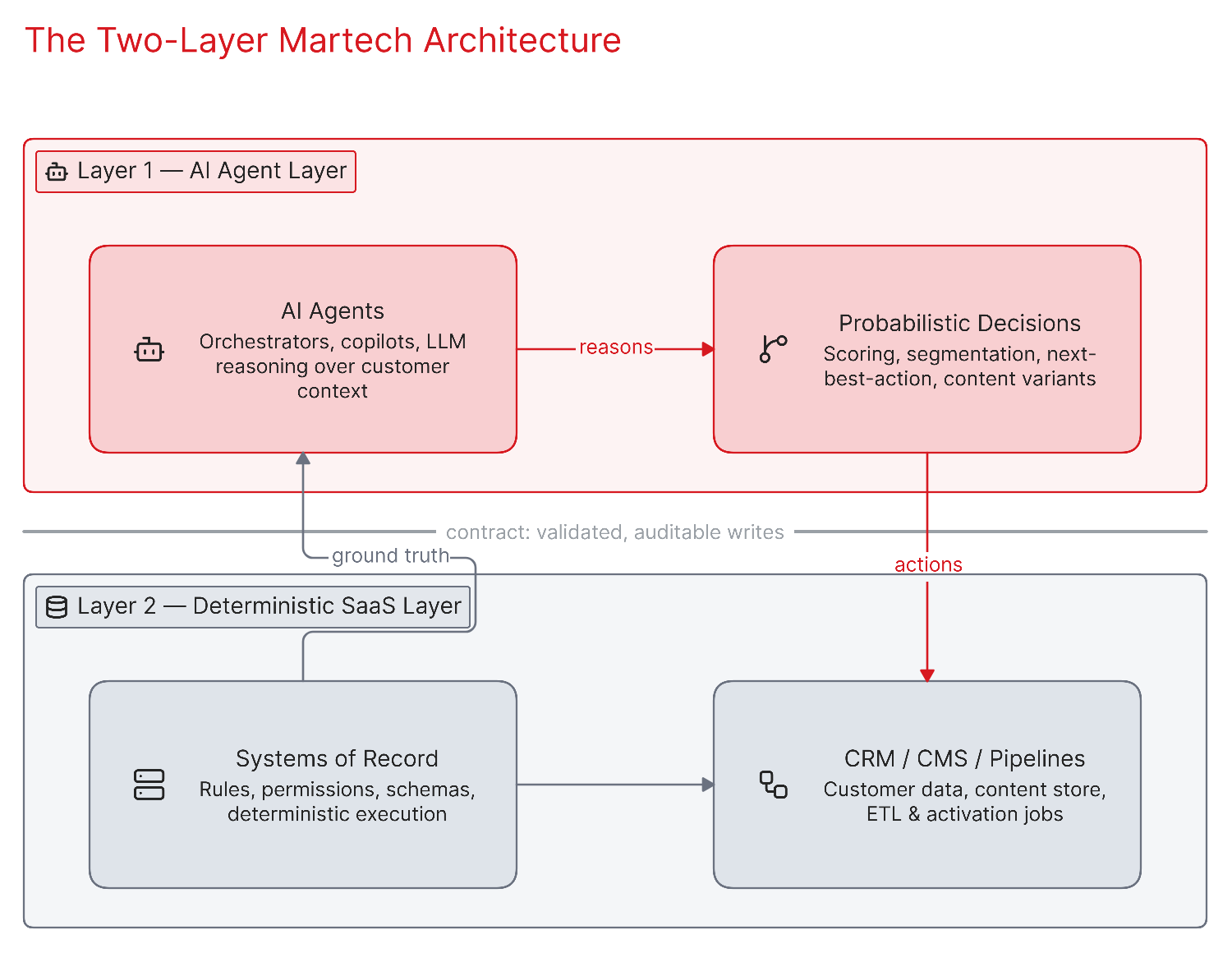
Layer one is deterministic SaaS. This is your CRM, your marketing automation platform, your CMS, your data pipelines. These systems are rule-based, reliable, and predictable. They do exactly what you configure them to do, every time. They are infrastructure, not intelligence.
Layer two is probabilistic AI agents. These operate on top of the SaaS layer, handling dynamic, context-dependent decisions: which content to surface, which segment to target next, how to adapt a journey in real time based on signals the deterministic layer cannot process at speed.
The relationship between these layers is complementary, not competitive. You cannot run AI agents without clean, reliable infrastructure underneath them. And you cannot compete on experience if your infrastructure never gets smarter than its last manual configuration. The organizations getting this right are investing in both layers deliberately, understanding which decisions belong where.
This has direct implications for how anyone approaches platform and data work. The assessment determines the architecture. The architecture determines the platform, not the other way around. Your SaaS layer produces the deterministic foundation, and your AI layer can only be as good as what that foundation feeds it. Skip the infrastructure and your agents have nothing reliable to act on. Skip the agents and your infrastructure never gets smarter.
Stratification changes how you audit your stack
If consolidation were real, a stack audit would be simple: fewer tools, bigger platforms, done. Stratification makes the audit harder and more valuable.
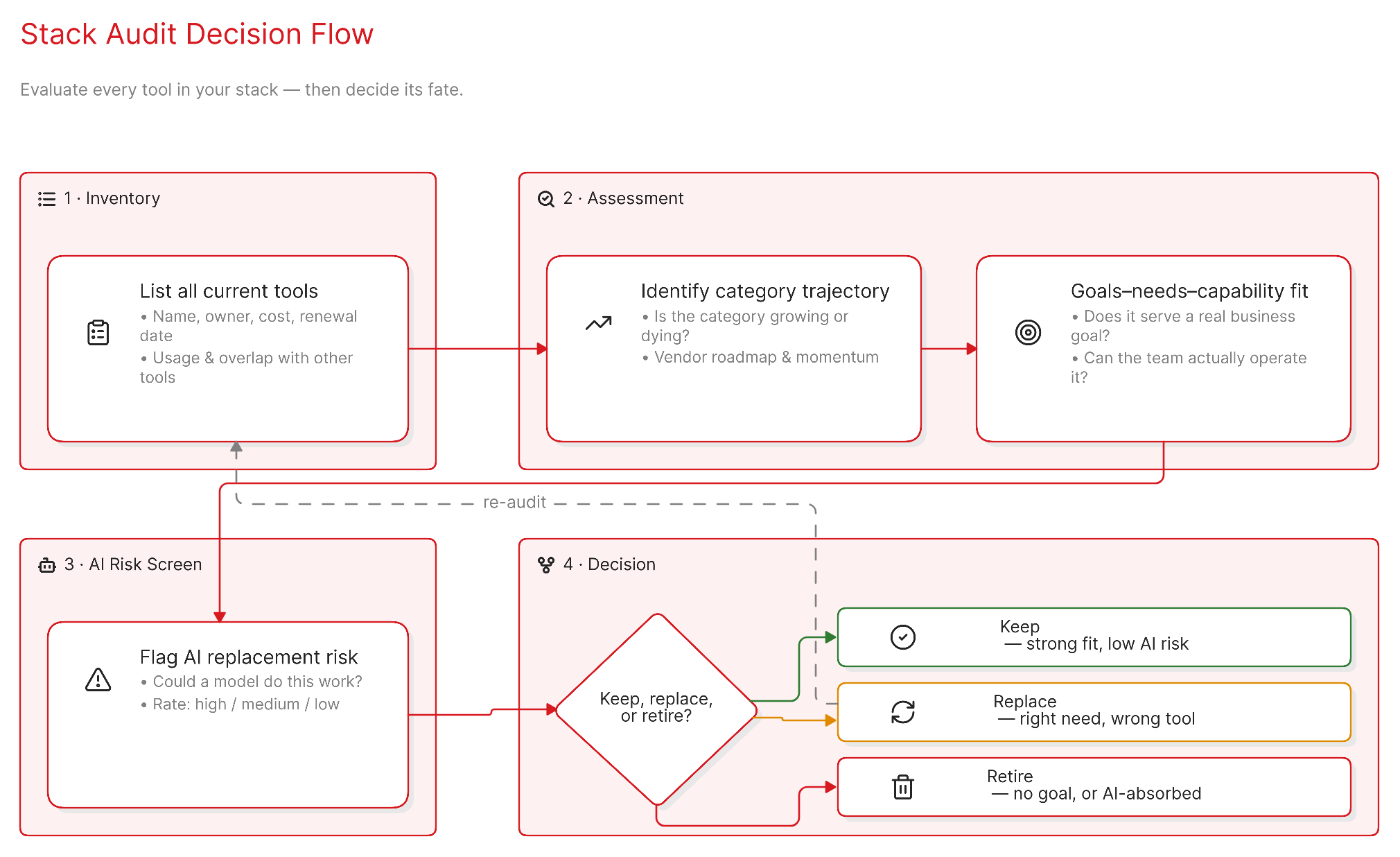
The right question is no longer "how many tools do we have? " It is "which of our tools sit in growing categories, which sit in declining ones, and which are doing work that an AI agent will do better inside two years? " That is a different conversation entirely. It requires looking at your stack not as a list but as a layered system with dependencies, and evaluating each component against where its category is headed.
The Brinker and Riemersma research proposes a scoping model built on three intersecting variables: your company's actual goals (not aspirational ones), your customers' real needs (observed, not assumed), and your current systems' genuine capabilities (not their feature lists). If a proposed tool or agent does not sit at the intersection of all three, it is not strategic. It is shelfware waiting to happen. One caveat: it is not entirely clear whether this scoping model originates from the keynote authors or from our own team's interpretation of their material. The framing is useful either way, but we name the uncertainty rather than paper over it. The underlying logic is sound regardless of who coined it: goals, needs, and system capability are the right variables. The question is whether this specific triangulation has been validated in live engagements. For us, it has not. Not yet.
The role shift no one is staffing for
The research also surfaces something most stack conversations ignore entirely: the people operating the stack are in the middle of a fundamental evolution, and most organizations have not noticed.
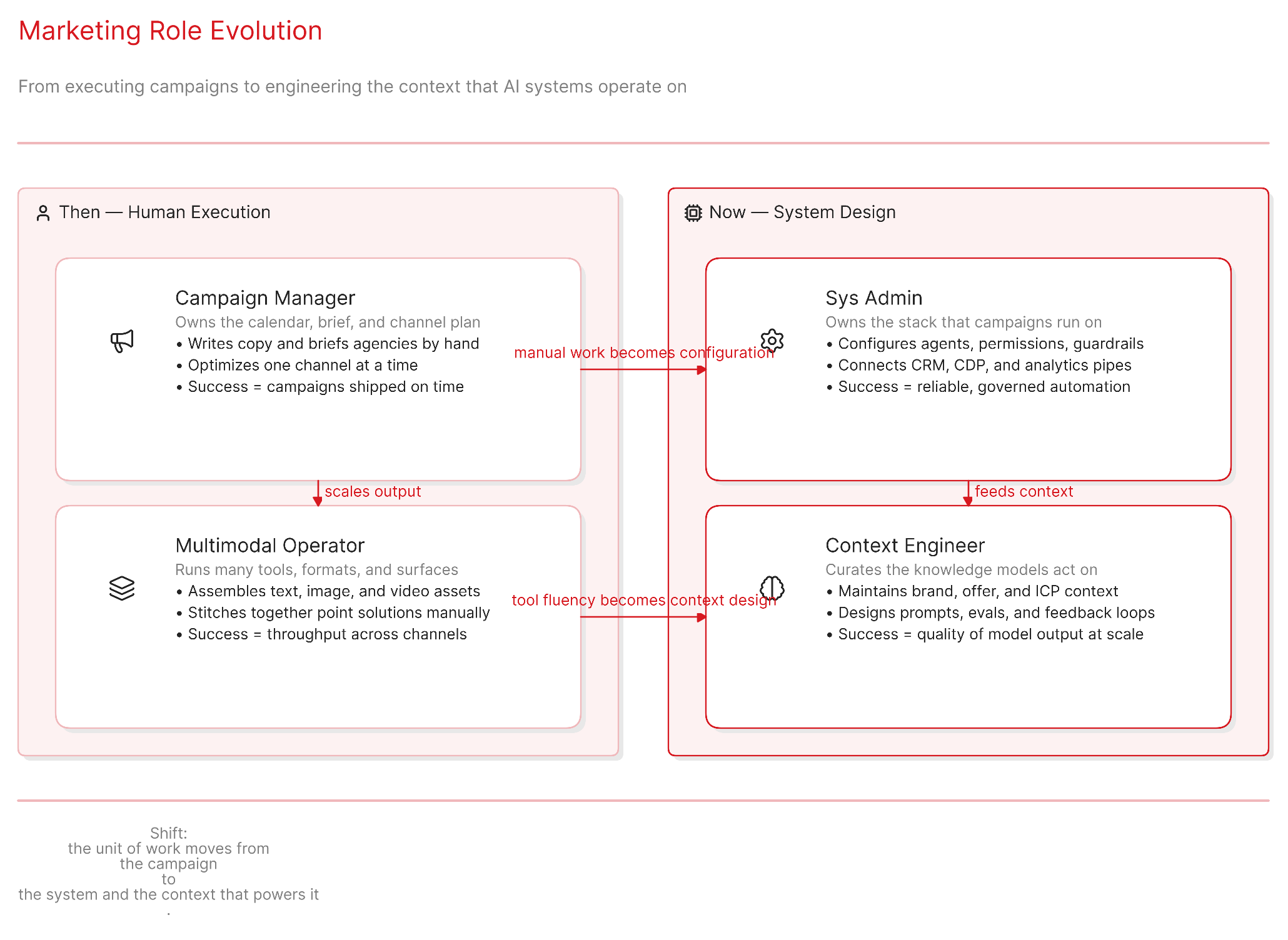
Campaign managers are becoming multimodal operators, managing not just email sequences but cross-channel orchestration across deterministic and probabilistic systems simultaneously. System administrators are becoming stack wranglers and, eventually, context engineers who configure not just platforms but the AI agents that sit on top of them.
This is not a five-year horizon. The shift is happening now, one workflow at a time, every time a team member moves from manually segmenting a list to configuring an agent that does it dynamically. The question for any organization is not "should we hire for this? " It is "where on this arc are our people today, and what do they need to move to the next stage? " That is a capability development question, not a hiring question, and treating it as pure recruitment guarantees you will be perpetually behind.
What this does not solve
These frameworks provide better mental models. They do not eliminate the hard work, and they carry their own limits.
We should be direct about where this piece sits: it is built on externally published research and internal strategic analysis, not on completed client engagements where we deployed these models and measured results. No organization we know of, including ours, has a validated playbook for operationalizing the two-layer model or the role evolution arcs at scale. The value is in the reframe, not in proven recipes.
Stratification means your audit is more nuanced, not simpler. The two-layer model gives you an architecture to think with, but it does not tell you which specific AI agents are ready for production in your context and which are still too unreliable to trust with customer-facing decisions. That evaluation is context-specific and changes quarter to quarter. The role evolution arcs describe a direction, not a training curriculum. And any scoping model, no matter how sound its logic, still requires honest inputs: goals that are real, customer needs that are researched rather than projected, and a systems assessment that accounts for technical debt rather than ignoring it.
The research also does not tell you what to do about the eight declining categories. If your stack is heavily invested in one of them, the strategic response depends on your migration readiness, your contractual commitments, and your team's capacity for change, not on a landscape chart.
What to do with this now
Map your stack against the two layers. List every tool. Mark each one as deterministic infrastructure or emerging AI/agent capability. Identify the gaps: where are you running a deterministic process that an agent could handle? Where are you running an agent without reliable infrastructure underneath it?
Audit against category trajectory, not feature comparison. For each tool in your stack, ask whether its category is growing, stable, or declining. A best-in-class tool in a declining category is a migration waiting to happen.
Assess your team against the role arcs. Not to create anxiety, but to create a development plan. Where are your people today? What would it take to move them one stage forward in the next six months? Start there.
If your stack decisions are stalled by the wrong mental model, talk to us about an assessment that maps what you actually have against where your categories and capabilities are headed.

Axelerant Editorial Team
The Axelerant Editorial Team collaborates to uncover valuable insights from within (and outside) the organization and bring them to our readers.

Leave us a comment