

 We respect your privacy. Your information is safe.
You have been told consolidation is coming. Hang tight, the market will simplify, the winners will emerge, and your stack decisions will get easier. The 2026 State of Martech research from Scott Brinker and Frans Riemersma says otherwise. The landscape just hit 15, 505 tools. It is not converging. It is stratifying: winners pulling ahead within categories, a long tail persisting, and entirely new categories growing while others quietly decline.
We see this in every stack audit we run. The client walks in expecting to hear "consolidate to three platforms. " What the audit actually reveals is a more nuanced picture: some tools sitting in growing categories where deeper investment makes sense, others anchored to categories that are hollowing out underneath them. The diagnosis is not "you have too many tools. " It is "you have tools in the wrong categories for where your customers are heading. "
The three defaults that keep you stuck
Most organizations respond to this complexity in one of three ways. The market will consolidate, so wait. AI will replace the stack, so hold off on platform investment. Or the landscape is too noisy to read, so do nothing.
All three produce the same outcome: decision paralysis. CMS, iPaaS, ecommerce, and workflow tooling are expanding. Eight other categories are in quiet decline. The organizations losing ground are treating martech as a single weather system when it is actually a landscape with microclimates.
The question worth asking is not "when will this simplify? " It is: which categories are growing or declining for my customers, and am I invested accordingly?
What stratification means for your next stack decision
A consolidating market rewards patience. A stratifying market rewards diagnosis. The difference changes the shape of every stack decision.
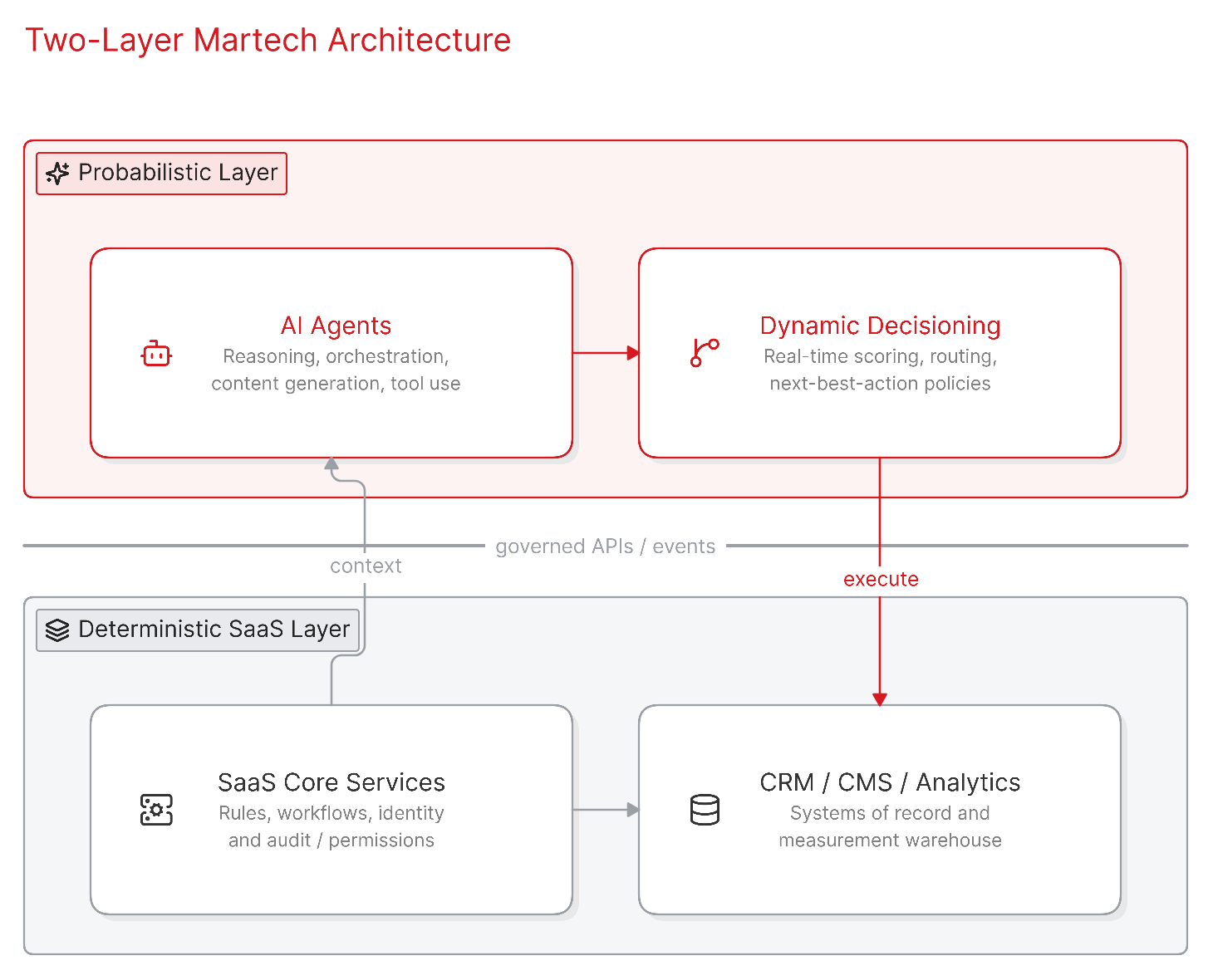
In a stratifying landscape, the useful audit is not "which tools overlap? " It is "which categories matter for our specific customer journeys, and where are we invested in a declining category when we should be shifting? " We ran exactly this kind of assessment for a client who came in asking for a platform migration. The migration turned out to be the wrong move. Two of their five core tools sat in growing categories and deserved deeper integration, not replacement. The third sat in a category where the entire competitive field was thinning. That tool needed sunsetting, not upgrading.
The sequence matters here. The assessment of customer journeys determines the architecture. The architecture determines the platform choices. Not the other way around. When you start from the vendor roster instead of the customer journey, you optimize for the stack you have rather than the journeys your customers actually take.
Two layers your architecture needs to account for
One of the most useful framings from the research is architectural. Your stack is becoming two distinct layers that work differently.
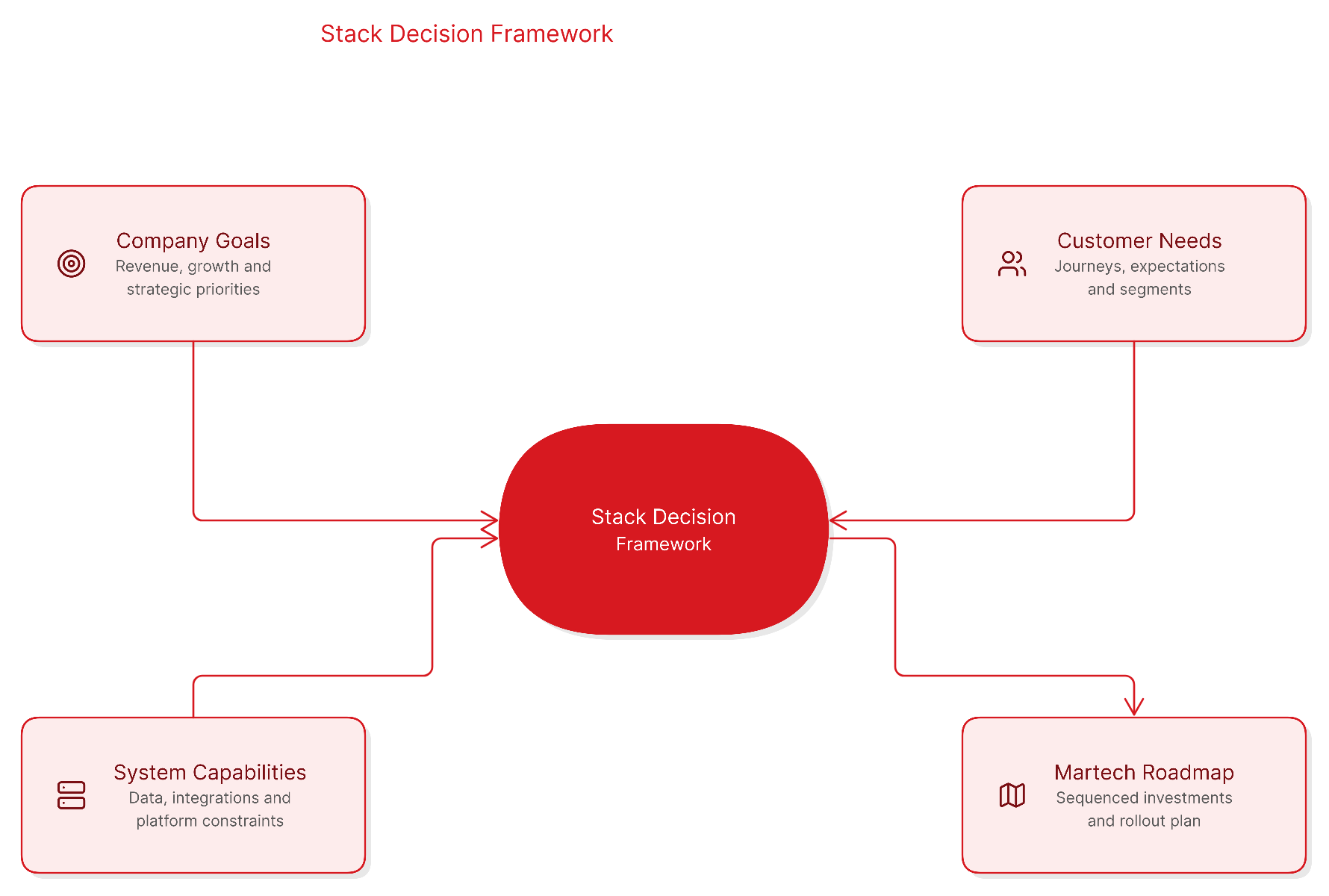
The deterministic layer is your SaaS infrastructure: CRM, marketing automation, CMS, analytics. Rule-based systems that do exactly what you configure them to do, every time.
The probabilistic layer is where AI agents operate, sitting on top of that infrastructure and handling dynamic, context-dependent decisions: personalizing content, adjusting targeting based on behavioral signals, triaging leads by intent patterns. They do not replace the deterministic layer. They depend on it.
An AI agent without reliable infrastructure underneath it is guessing without guardrails. But the boundary between these layers is blurrier than any diagram suggests. Your CRM's lead scoring is already somewhat probabilistic. Your AI agent still needs deterministic rules for compliance and data governance. We have learned this the hard way: clients who bolt a probabilistic tool onto a fragmented data foundation get noise, not intelligence. The platform architecture has to be sound before the AI layer earns its keep.
This is why both the "replace everything with AI" and "ignore AI entirely" positions fail. The deterministic layer is not going away. The probabilistic layer is not optional. Build the foundation first so the agents have clean data to work with.
Scoping what to do next
When every vendor promises AI transformation and every analyst publishes a new framework, the practical question is: how do you decide what to invest in next?
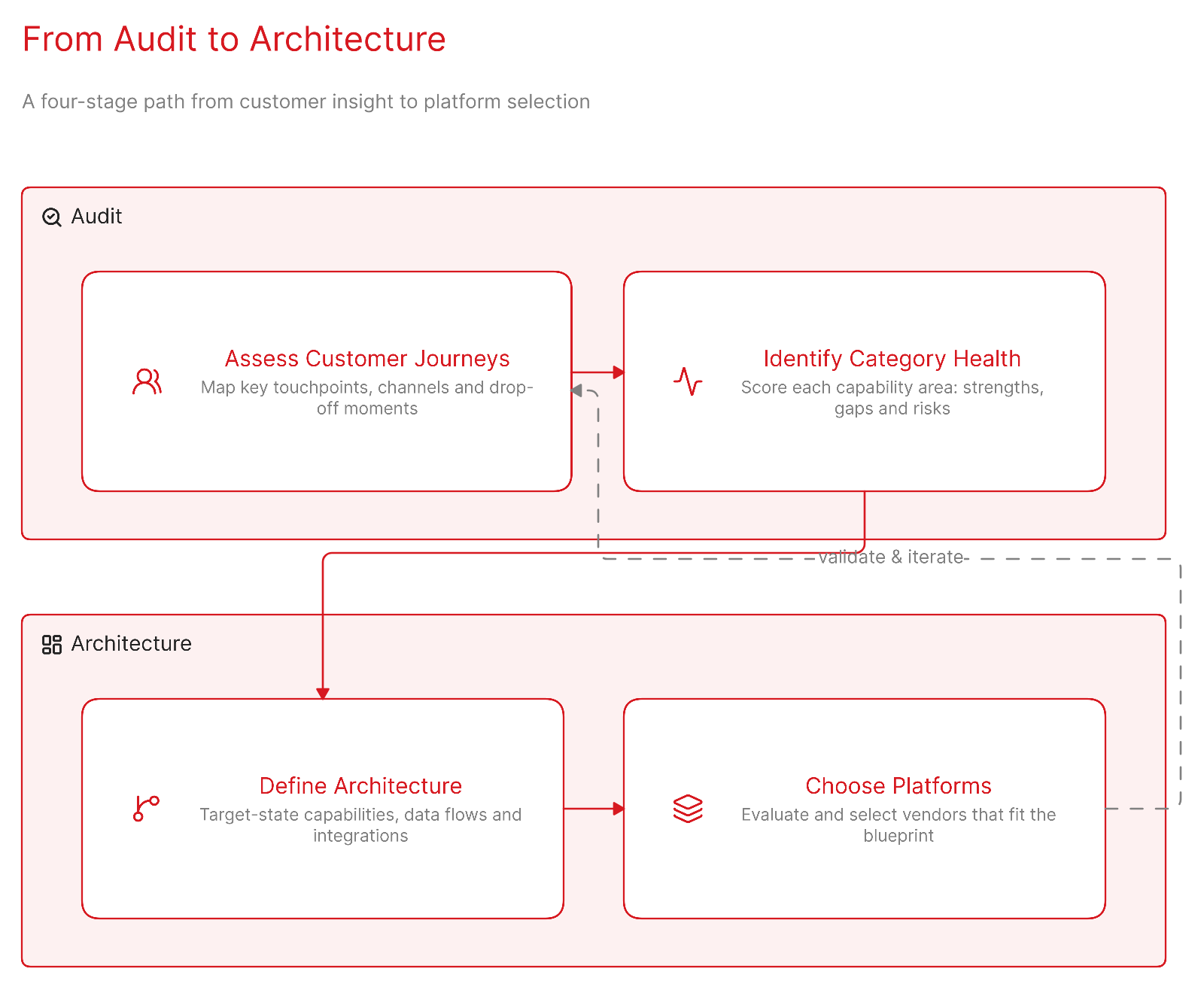
One framing surfaced from the research (its exact provenance in the keynote is worth verifying) holds the essential variables in tension: your company's goals, your customers' actual needs, and your systems' current capabilities. Any martech decision that optimizes for only one or two of these produces familiar failures.
Goals without customer insight produces campaigns nobody wants. Customer insight without system capability produces strategies you cannot execute. System capability without clear goals produces an impressive stack that does not move revenue.
The gaps between these three define the roadmap. The roadmap sequences the investment. Not a single big bet, but a defensible series of smaller ones, each grounded in what you actually know about your context rather than what the market might do next.
What this does not solve
A stratification lens helps you make better stack decisions. It does not tell you which specific platform to buy. It does not resolve the organizational politics that keep teams siloed around tools they have outgrown. And it does not address the very real question of how marketing roles need to evolve as the work shifts from single-channel campaign management toward cross-platform orchestration and systems thinking. That is a separate, harder problem that most organizations are only beginning to name.
The shift from marketer-optimized to agent-optimized customer journeys is real and near-term, but "near-term" still means messy. Most organizations will live in the transition for years: some channels agent-optimized, others still manually managed, the team learning as it goes. No single audit or architectural decision closes that gap. What it does is give you a defensible starting position: a stack diagnosed against your actual customer journeys, an architecture that accounts for both layers, and a sequence of investments you can explain to your board without relying on a consolidation wave that is not coming.

Axelerant Editorial Team
The Axelerant Editorial Team collaborates to uncover valuable insights from within (and outside) the organization and bring them to our readers.

Leave us a comment