

 We respect your privacy. Your information is safe.
The Meeting Where Everything Goes Wrong
Every agency knows the meeting. Three rounds of creative are on the table. The strategy was approved. The brief was signed off. The design team executed exactly what was asked for.
And the CMO says, "This just doesn't feel right. "
What follows is predictable: two more rounds of revisions, a quietly expanded scope, a team that loses momentum, and a margin that evaporates. One agency founder who tracked this pattern reported absorbing $50K or more in unrecoverable rework cost. Not on one catastrophic project, but across a recurring pattern of engagements where "alignment" turned out to mean "everyone nodded at the same meeting but imagined different outcomes. "
That figure comes from a single agency's self-reported experience, shared through a community event rather than an audited case study. The exact calculation method is unknown. But the pattern it points to is one nearly every creative services team recognizes: rework driven not by bad design, but by direction that was never validated in the first place.
This is not a design quality problem. It is an evidence problem. And it starts before the brief is ever written.
Where The Money Actually Disappears
The instinct is to blame creative execution. The concept was not bold enough, not refined enough, not "on brand" enough. But when you trace rework back to its origin, the failure point is almost always upstream.
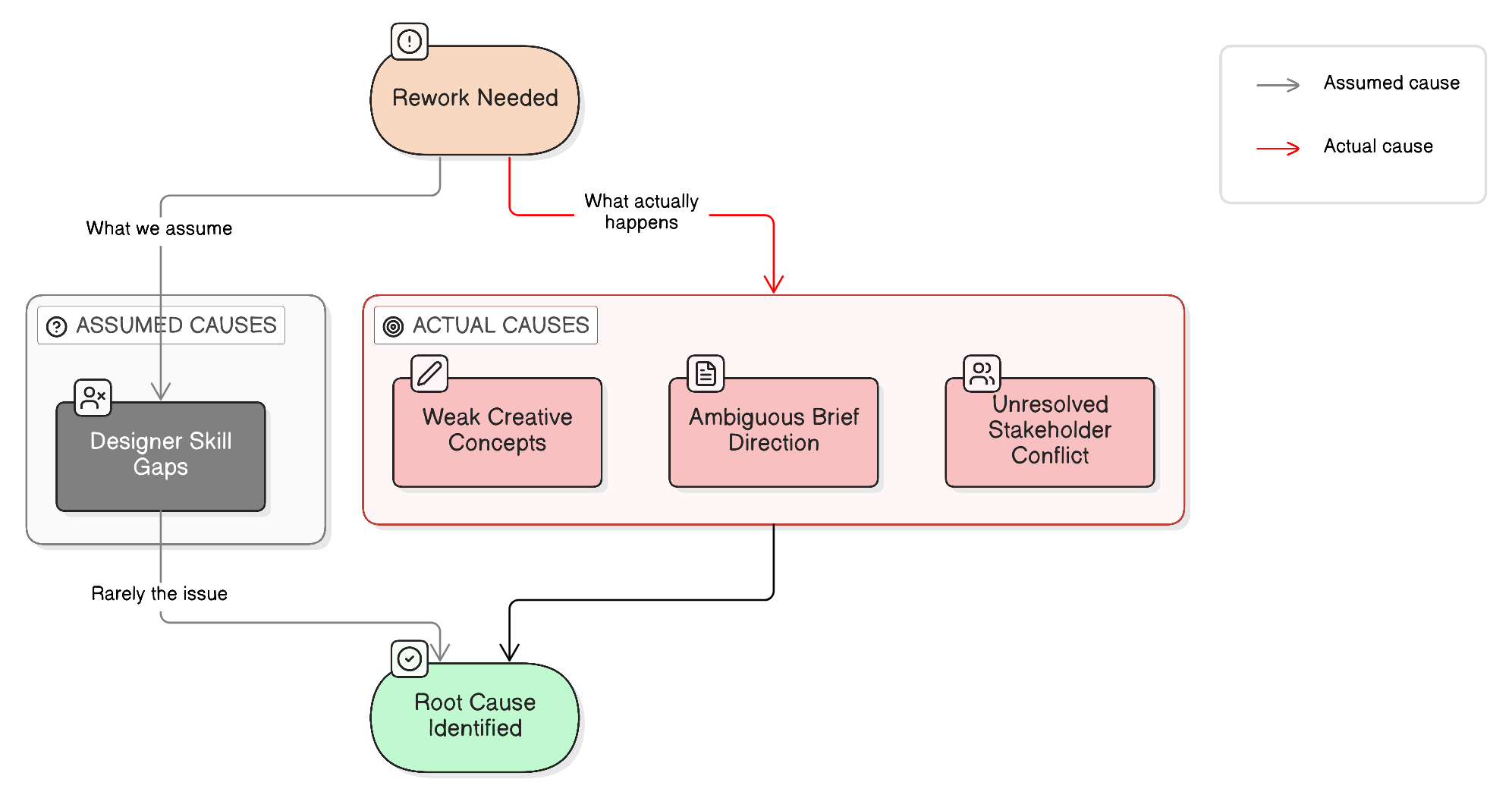
| Assumed Cause | More Likely Actual Cause |
|---|---|
| Weak creative concepts | Ambiguous creative direction in the brief |
| Misunderstanding of brand guidelines | Stakeholders with competing internal visions of the brand |
| Insufficient designer skill | No external evidence to arbitrate between subjective preferences |
| Scope creep from the client | Scope creep from unresolved internal disagreement surfacing late |
| Not enough revision rounds | Too many revision rounds compensating for a direction that was never validated |
This mapping is reconstructed from common agency experience, not from a controlled study. But the directional logic is consistent with how branding engagements typically break down: the most senior stakeholder's preference wins, regardless of whether it matches the audience the brand is trying to reach. Alignment meetings produce consensus. They do not produce evidence. And consensus without evidence is just the path of least organizational resistance.
The Timing Problem With Concept Testing
The obvious response is: test it. Run concepts past real audiences. Gather data.
But traditional concept testing happens after creative production. The designs exist. The team has invested weeks. The agency has spent real money. At that point, audience feedback does not prevent rework. It causes it, just with data attached.
| Approach | When It Happens | What It Tests | Cost Of A Wrong Answer |
|---|---|---|---|
| Stakeholder alignment workshops | Before the brief | Stakeholder preferences (not audience perception) | Low cost, but low validity |
| Mood board reviews with stakeholders | During briefing | Whether stakeholders agree with each other | Low cost, but still opinion-based |
| Traditional concept testing | After creative production | Whether audiences respond to finished work | High cost: rework requires reproducing creative from scratch |
| Pre-brief audience validation | Before the brief is locked | Whether the creative territory resonates with the target audience | Low cost: direction shifts are cheap before production starts |
The leverage point is clear in theory. The cheapest time to change direction is before you have committed resources to producing that direction. But that window, the pre-brief window, is almost always governed by stakeholder opinion rather than audience evidence.
A Proposed Pre-Brief Validation Framework
The following framework is not presented as a proven methodology with documented outcomes. It is a logical model built from the core insight that emerged from the rework problem described above: audience evidence gathered before the brief is locked should reduce expensive direction changes during production. The steps are reconstructed from the general approach, not from verified implementation data.
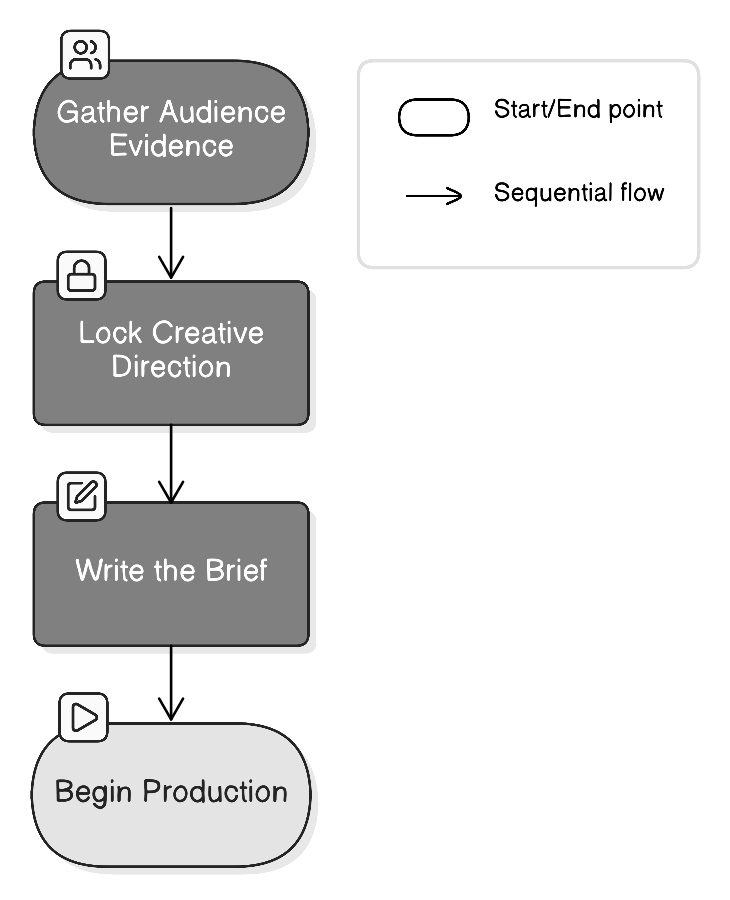
This framework needs real-world testing and measurement before it can be treated as validated. What it offers now is a structured way to think about moving evidence upstream.
Step 1: Define The Perceptual Territory, Not The Deliverable
Before briefing, identify the perceptual territory the brand needs to occupy. This is not "design a logo that feels modern. " It is "determine whether the target audience associates visual warmth or visual precision with trust in this category. "
The shift is from prescriptive direction ("make it bold and colorful") to diagnostic inquiry ("what visual language does our audience associate with the attributes we need to own? ").
Step 2: Curate Visual Stimuli That Represent Competing Directions
Assemble image sets that represent distinct creative territories. These are not concepts. They are reference images, mood fragments, color systems, typographic tones, and photographic styles that represent the range of directions the brief could go.
The key constraint: these must be diverse enough to surface real preference differences, not so similar that they produce false consensus.
Step 3: Collect Audience Reactions At Scale
Present these visual stimuli to a representative sample of the target audience. Capture their perceptual and emotional responses. Not "which do you prefer" (preference is not perception) but "what do you associate with this" (perception reveals positioning opportunity).
Scale matters here. A stakeholder workshop captures 4 to 8 opinions. A scaled audience study captures hundreds or thousands. The statistical weight changes the conversation from "I think" to "they show. "
Critical open questions remain about this step: what sample sizes produce reliable signal, how audience panels should be recruited, and whether image-based perception data actually predicts downstream creative effectiveness. These are testable hypotheses, not settled science.
Step 4: Brief From Evidence, Not From Consensus
Use the audience perception data to inform the creative brief. The brief is no longer "what the stakeholders agreed on. " It is "what the audience data suggests will resonate, presented to stakeholders as evidence. "
This should change stakeholder dynamics. The conversation shifts from "which direction do we like" to "which direction does our audience respond to. " Whether stakeholders actually accept external data over their own instincts is an implementation variable that depends on organizational culture and how the data is presented.
Step 5: Use The Data As A Reference Point Throughout Production
When creative is reviewed, evaluate it against the audience perception data, not against stakeholder taste. "Does this align with what we learned about how our audience perceives trust? " is a different question than "does the CEO like blue? "
Why This Could Be A Structural Advantage
The immediate potential benefit is financial: fewer rework rounds, tighter scopes, protected margins. But the deeper potential advantage is strategic.
| Dimension | Without Pre-Brief Validation | With Pre-Brief Validation (Hypothesized) |
|---|---|---|
| Creative direction authority | Highest-ranking stakeholder | Target audience data |
| Brief confidence | Based on internal agreement | Based on external evidence |
| Revision dynamics | "I don't like it" triggers rework | "The data supports this direction" anchors decisions |
| Stakeholder management burden | High: agency mediates between competing opinions | Lower: agency presents evidence and facilitates interpretation |
| Margin protection | Vulnerable to subjective scope creep | Anchored to validated direction |
| Client trust trajectory | Rebuilt after every painful revision cycle | Established early through demonstrated rigor |
These are projected outcomes, not measured results. No published before/after data exists for this specific approach. The logical case is strong: evidence should outperform opinion when the goal is audience resonance. But "should" is not "does, " and teams considering this approach should plan to measure their own results.
For agencies navigating a market where execution is increasingly commoditized, the strategic positioning argument is worth considering. An agency that can say "we validated this direction with hundreds of members of your target audience before we designed anything" occupies a different position than one that says "we ran a brand workshop and this is what felt right. " Whether that positioning translates to measurable client acquisition or retention advantage is an open question.
The Conditions That Make This Worth Testing
Pre-brief validation is not universally applicable. It is most likely to pay off under specific conditions.
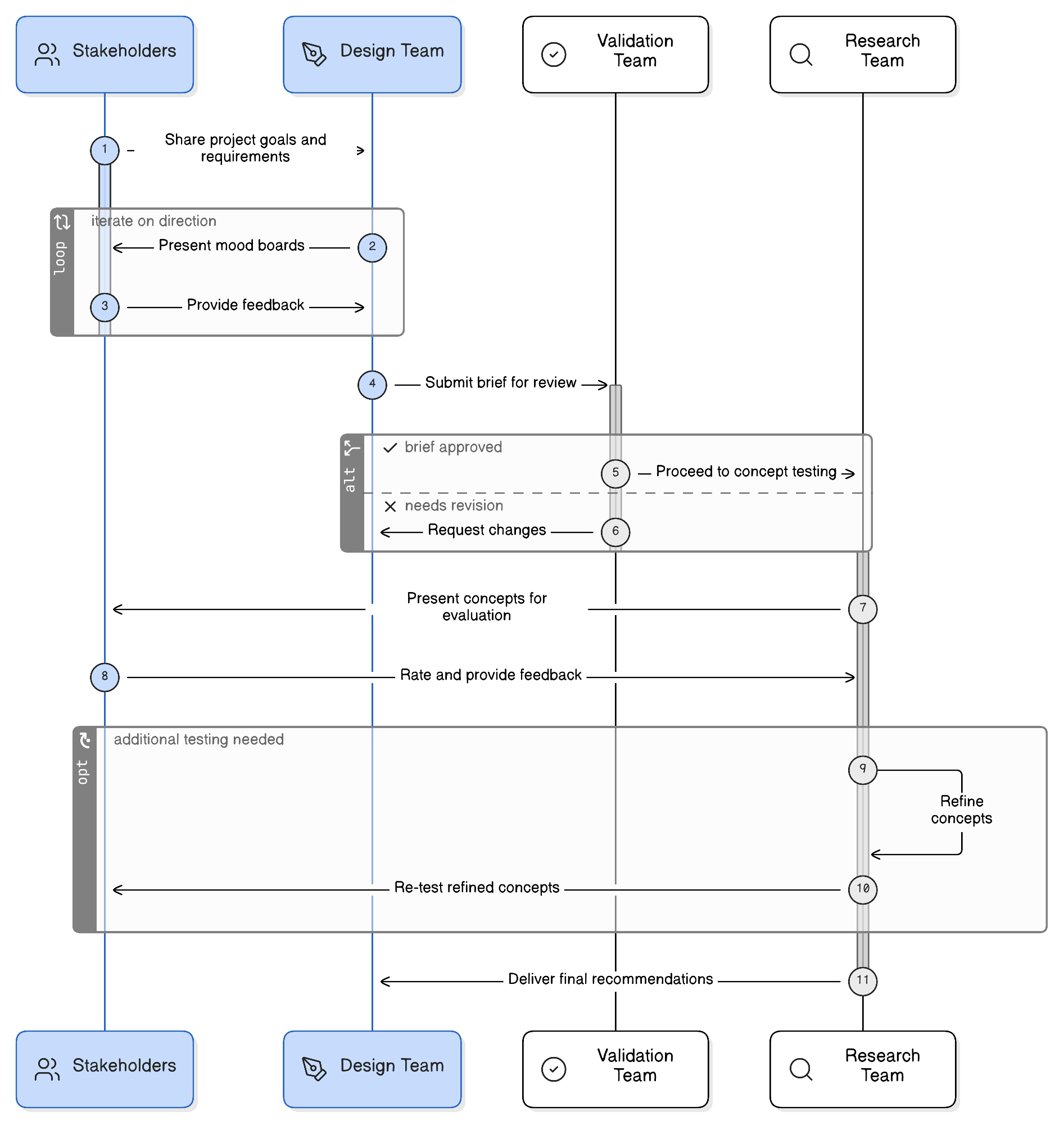
Higher applicability:
- Multiple stakeholders with decision authority over creative direction
- Brand identity or repositioning engagements where direction is ambiguous
- Categories where audience perception and stakeholder assumption frequently diverge (financial services, healthcare, technology)
- Engagements with budgets large enough that rework costs are material
Lower applicability:
- Single decision-maker engagements where alignment is not the bottleneck
- Tactical executions (a banner ad, a social post) where the cost of being wrong is low
- Engagements where the brand territory is already established and the brief is execution-focused
The honest cost caveat: This approach adds time and cost to the pre-brief phase. It pays for itself only when the alternative is expensive rework. For a $10K project, adding a validation phase may not pencil out. For a $150K rebrand, absorbing even one unnecessary revision cycle likely costs more than the validation ever would. But until teams measure both sides, that math remains an estimate rather than a fact.
What This Means For Design And Delivery Teams
The pre-brief validation pattern, if it proves out, extends beyond branding. Any discipline that suffers from subjective stakeholder override during production could benefit from front-loading external evidence.
UX teams navigating competing opinions about information architecture can validate user mental models before wireframing. Product teams arguing about feature priority can test value perception before sprint planning. Content strategists debating tone of voice can test audience resonance before editorial guidelines are written.
The transferable principle: when decisions are subjective and stakes are high, move evidence gathering upstream of commitment. The cheapest revision is the one that never needs to happen.
This is a hypothesis worth testing, not a proven playbook. The agency founder who surfaced this pattern has built tooling around it, and early signals suggest the logic holds. But the industry needs documented results: measured reductions in revision rounds, quantified margin recovery, and honest accounting of where the approach fails. Until that evidence exists, treat this as a compelling experiment rather than an established best practice.
Frequently Asked Questions
What Is Pre-Brief Creative Validation?
Pre-brief creative validation is the practice of collecting audience perception data on visual or strategic direction before finalizing a creative brief. It replaces subjective stakeholder alignment with scaled external evidence, aiming to ensure creative production is anchored to audience response rather than internal opinion. The approach is emerging and lacks published outcome data, but addresses a well-documented industry pain point.
How Much Does Creative Rework Actually Cost Agencies?
One branding agency founder self-reported $50K or more absorbed across multiple engagements, including direct team hours and margin erosion from scope expansion. That figure has not been independently verified. Industry-wide, rework costs vary significantly by agency size and engagement value, but revision cycles consistently represent one of the largest controllable cost leaks in creative services delivery.
When Should Teams Skip Pre-Brief Validation?
Skip it when the cost of being wrong is low, when a single decision-maker eliminates alignment risk, or when the project budget cannot absorb the added pre-brief investment. A $10K tactical engagement rarely justifies a formal validation phase. A six-figure rebrand with a multi-person steering committee is where the approach is most likely to return its cost in reduced rework.
How Is This Different From A/B Testing Or Concept Testing?
A/B testing and concept testing evaluate finished or near-finished creative, meaning production costs are already sunk when feedback arrives. Pre-brief validation tests creative territories and perceptual directions before any concept is produced. The intervention point is earlier, the cost of adjustment is lower, and the goal is direction validation rather than execution optimization.
Can Internal Teams Use This Approach Without Specialized Tools?
Yes. The principle works with any method that collects audience perception data at scale before a brief is locked. Survey platforms, unmoderated research tools, and structured social listening can approximate the approach. The strategic value comes from the timing of evidence gathering and the shift in stakeholder dynamics, not from any particular platform or proprietary methodology.

Axelerant Editorial Team
The Axelerant Editorial Team collaborates to uncover valuable insights from within (and outside) the organization and bring them to our readers.

Leave us a comment