

 We respect your privacy. Your information is safe.
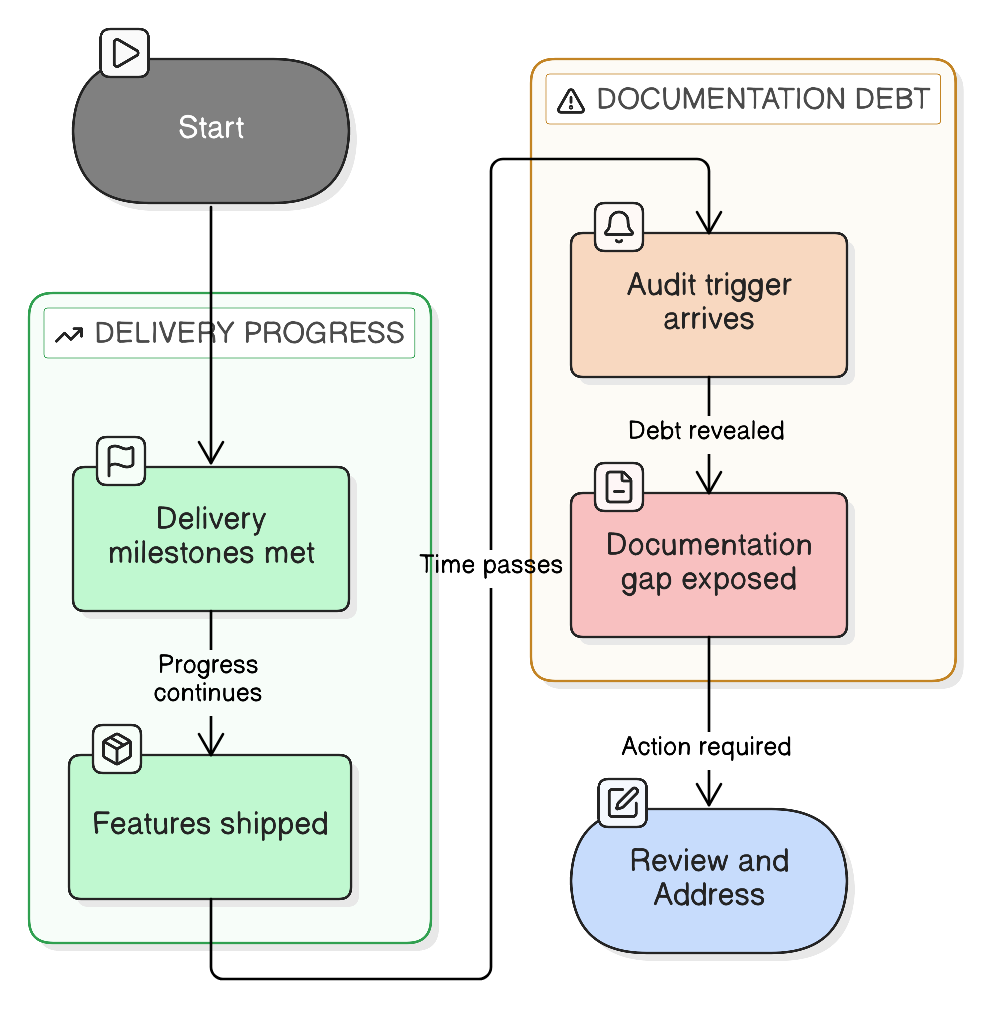
Here is a scenario most delivery teams will recognize. A system is live. It has been live for months, maybe longer. The team has shipped features, resolved incidents, maintained uptime. By every delivery metric that matters day to day, the project is healthy.
Then the client sends an email requesting an operations manual, code repository documentation, and architecture diagrams. A routine audit. Maybe compliance-driven, maybe contractual, maybe preparation for a vendor transition. The reason does not matter. What matters is that the documentation does not exist.
This happened on one of our engagements. A client-initiated audit surfaced that a live production system had no consolidated operations manual, incomplete code repository documentation, and no architecture diagrams. The artifacts that did exist were fragmented across two separate platforms with no single source of truth. A delivery manager and two engineers spent an unplanned block of time locating, consolidating, and creating documentation under deadline pressure while their other delivery commitments continued.
We do not have complete data on the outcome of that specific scramble. We do not know exactly how many hours it consumed or whether the client was fully satisfied. What we do have is a problem pattern we have seen recur across enough engagements to build a model for preventing it. The four-layer model below draws on that accumulated experience, not solely on this one incident.
Why Documentation Debt Is Not Technical Debt
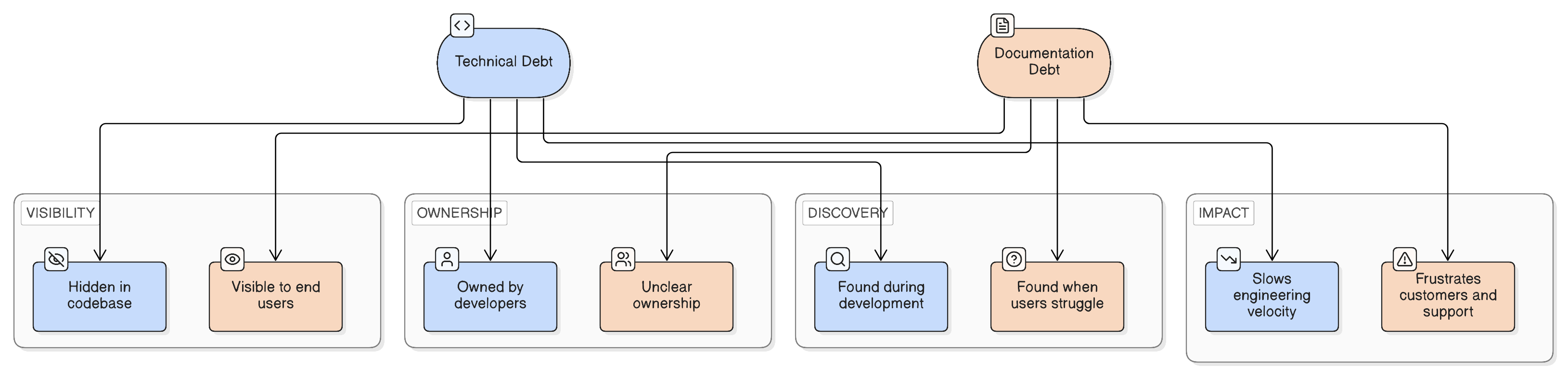
Technical debt is a well-understood concept. Teams accumulate it knowingly, track it in backlogs, and pay it down strategically. Documentation debt operates differently, and the differences make it more dangerous.
| Dimension | Technical Debt | Documentation Debt |
|---|---|---|
| Visibility | Surfaces in code reviews, performance metrics, build times | Invisible until an external event triggers discovery |
| Ownership | Engineering team owns and can prioritize | Often falls between roles: no single owner |
| Accumulation Pattern | Conscious tradeoff ("we will refactor later") | Unconscious omission ("nobody asked for it") |
| Discovery Trigger | Internal: degraded velocity, increased bugs | External: audit, transition, incident requiring runbooks |
| Recovery Cost | Proportional to codebase complexity | Proportional to team turnover and time since original decisions |
| Stakeholder Impact | Internal friction | Client trust erosion, contractual risk |
The last row matters most. Technical debt slows your team down. Documentation debt damages your client relationship at exactly the moment the client is evaluating your rigor.
The Institutional Knowledge Problem
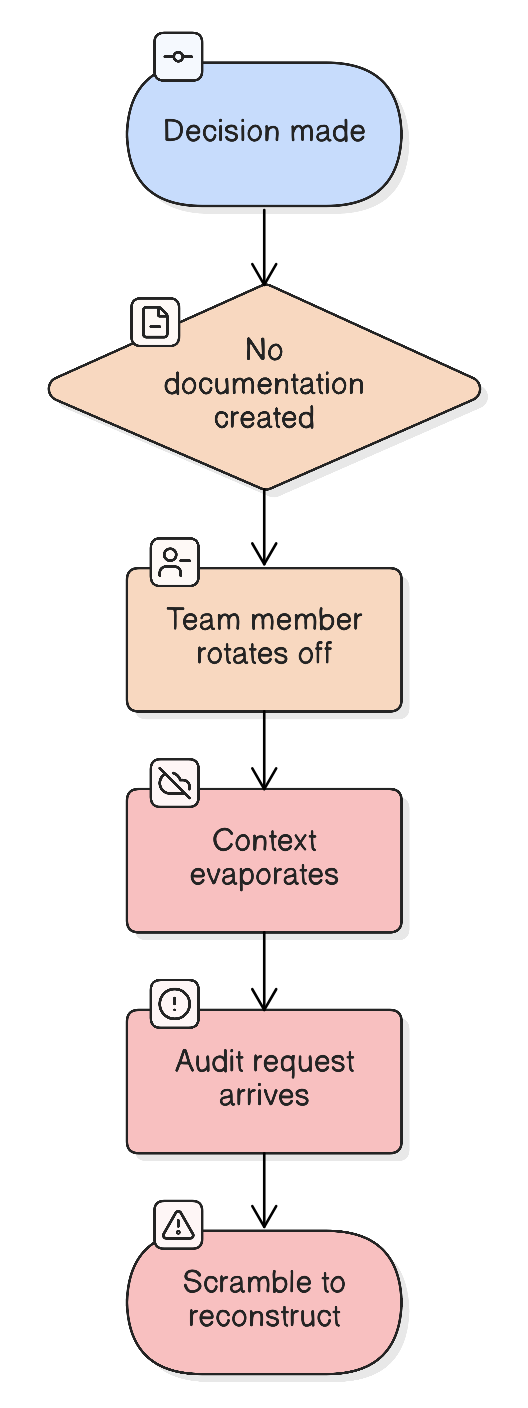
Documentation debt compounds in a way code debt does not. When the engineer who made an architecture decision is still on the team, recreating that decision's rationale takes an hour. When that engineer rotated off six months ago, it takes a week of archaeology across commit histories, old chat threads, and guesswork.
This is the compounding function most teams ignore: documentation debt accrues interest in direct proportion to team turnover. A project with zero attrition over two years might survive an audit through tribal knowledge alone. A project with normal rotation patterns across the same period will find that critical context has simply evaporated.
The fragmentation problem makes this worse. When artifacts live across multiple platforms, README files, and wiki pages with no enforced structure, even documentation that technically exists becomes functionally invisible. The scramble is not just "create what is missing. " It is "figure out what exists, where it lives, whether it is current, and what gaps remain. " All before the actual writing begins.
The Agile Documentation Paradox
The Agile Manifesto values "working software over comprehensive documentation. " This is frequently interpreted as permission to skip documentation entirely. That interpretation is wrong, but it is understandable. When sprint capacity is finite and the client is asking for features, documentation loses every prioritization conversation.
The paradox: Agile's emphasis on working software assumes a context where the same team maintains the software indefinitely. In agency and consultancy delivery, that assumption rarely holds. Teams rotate. Clients transition vendors. Contractual audits happen. Compliance reviews happen. The "working software" the Agile Manifesto values becomes a liability when nobody can explain how it works, how to operate it, or what architectural decisions constrain its evolution.
This is not an argument against Agile. It is an argument that Agile's documentation guidance was written for product companies, not for delivery organizations operating under client contracts with governance obligations.
The Audit-Ready Baseline: A Four-Layer Model
The model below addresses the root causes behind every documentation scramble we have observed: no index of what should exist, no recurring check on whether it does, no platform discipline, and no pre-built mapping to what auditors actually ask for.
Layer 1: The Documentation Manifest
Every project starts with a documentation manifest: a single page that lists every required deliverable, its owner, its location, and its current status. This is not the documentation itself. It is the index. When an audit arrives, the first question is always "what do we have and where is it? " The manifest answers that question in minutes, not days.
A manifest for the engagement described earlier would have looked something like this:
| Document Type | Owner (Role) | Platform | Status |
|---|---|---|---|
| Operations manual | Lead engineer | Primary wiki | Draft, not yet reviewed |
| Architecture diagrams | Solution architect | Primary wiki | Current |
| Code repository docs | Engineering team | Repository README | Outdated, needs update |
| Runbooks | DevOps engineer | Primary wiki | Not yet created |
| Data flow diagrams | Lead engineer | Primary wiki | Current |
The manifest makes documentation debt visible. Visible debt gets prioritized. Invisible debt does not. The point is not that every row shows "current. " The point is that every row shows something, so gaps are known quantities rather than surprises.
Layer 2: Cadenced Health Checks
Documentation review becomes a recurring ceremony, not an annual scramble. The delivery manager adds a single agenda item to an existing recurring meeting (sprint review, monthly health check, whatever cadence already exists): "Are all manifest items current? " This takes a few minutes when documentation is healthy. It takes zero additional meetings.
The cadence matters more than the depth. A brief check every few weeks that catches drift early is worth more than a comprehensive review every few months that discovers a full quarter of accumulated gaps.
Layer 3: Platform Consolidation
One platform. One structure. No exceptions.
The fragmentation across two platforms in the audit scramble described above was not a tooling problem. It was a discipline problem. Teams use multiple platforms because no one enforced a single standard at project inception. The rule is simple: pick one documentation platform at project kickoff, define the folder structure, and redirect every "I will just put this somewhere convenient" impulse back to the canonical location.
This does not require migration of historical artifacts. It requires a decision going forward and a delivery manager willing to enforce it.
Layer 4: Audit Packaging
The top layer is a pre-built export template that maps internal documentation to common audit request formats. Most audits ask for the same categories: operational procedures, architecture overview, security documentation, code management practices, disaster recovery.
| Common Audit Category | Maps To Internal Document |
|---|---|
| Operational procedures | Operations manual, runbooks |
| System architecture | Architecture diagrams, data flow docs |
| Code management | Repository README, branching strategy, CI/CD docs |
| Security posture | Security review docs, access control matrix |
| Disaster recovery | DR plan, backup procedures, RTO/RPO documentation |
A packaging template that maps these categories to internal document locations turns a multi-day scramble into an assembly task. The structural argument is straightforward: retrieval is always faster than creation.
The Delivery Manager's Role
This model only works if someone owns it. That someone is the delivery manager. Not because documentation is a management task, but because documentation readiness is a delivery risk, and delivery risk is a management accountability.
The specific responsibilities are narrow:
- Create the documentation manifest at project kickoff (or retroactively for active projects).
- Add a brief health check item to an existing recurring meeting.
- Enforce platform consolidation by redirecting artifacts that appear in the wrong location.
- Maintain the audit packaging template.
None of these require the delivery manager to write documentation. They require the delivery manager to make documentation debt visible and to ensure engineers have the time and clarity to address it.
What This Means For Your Projects
If you run delivery for client-facing engagements, audit every active project against these four questions:
- Could you produce an operations manual, architecture diagrams, and code repository documentation for any live system within 24 hours?
- Do you know, right now, which documentation exists and where it lives for each project?
- Is your documentation on one platform or scattered across two or more?
- If the original architect left tomorrow, could someone else reconstruct the system's design rationale from existing artifacts?
If you answered "no" to any of these, you have documentation debt. The only question is whether you address it on your own schedule or on your client's.
Frequently Asked Questions
How Do You Convince Engineers To Prioritize Documentation When Sprint Capacity Is Already Full?
Frame it as delivery risk, not administrative overhead. Present the concrete scenario: a client audit arrives and the operations manual does not exist. The Audit-Ready Baseline keeps ongoing cost to a few minutes per existing meeting. That cost rarely competes with feature work for capacity. Engineers resist "write more docs. " They accept "spend three minutes confirming the manifest is current. "
Does The Audit-Ready Baseline Require Migrating All Legacy Documentation To A Single Platform?
No. Platform consolidation applies going forward, not retroactively. Enforce one canonical location for all new artifacts created after the decision. Migrate legacy documents incrementally as they come up for review during cadenced health checks. Attempting a bulk migration creates disruption disproportionate to the value gained. The manifest itself bridges the gap by indexing documents regardless of where they currently live.
What Makes Documentation Debt Harder To Manage Than Technical Debt In Practice?
Technical debt has natural feedback loops: slower builds, failing tests, increasing bug counts. Documentation debt has no feedback loop until an external event, an audit, a team transition, a production incident requiring a runbook that does not exist, forces discovery. This absence of organic signals is why the manifest and cadenced review layers exist. They create an artificial feedback loop for a problem that otherwise stays invisible until it becomes urgent.
Start Before The Audit Email Arrives
Run the audit readiness check on one active project this week. Take the four questions from the section above and answer them honestly for your highest-risk engagement. If the answers concern you and you want to talk through what the Audit-Ready Baseline looks like in practice, reach out to our delivery practice team.
Or start smaller. Pick one active project. Spend two hours building a documentation manifest: every required deliverable, its owner, its location, its status. That single artifact will tell you more about your documentation debt than any audit ever could. If you want help structuring the manifest or the broader model, let us know.

Axelerant Editorial Team
The Axelerant Editorial Team collaborates to uncover valuable insights from within (and outside) the organization and bring them to our readers.

Leave us a comment